
Tyger Tyger, burning bright,
In the forests of the night;
What immortal hand or eye,
Could frame thy fearful symmetry?
In what distant deeps or skies,
Burnt the fire of thine eyes?
On what wings dare he aspire?
What the hand, dare seize the fire?
What the hammer? what the chain,
In what furnace was thy brain?
What the anvil? what dread grasp,
Dare its deadly terrors clasp!
– William Blake, The Tyger (1794)
Replied the page: “that little buzzing noise….
Comes from a play-thing of the Emperor’s choice,
From a Man-Tiger-Organ, prettiest of his toys.
– John Keats, The Cap and Bells (1819)
He says the best way out is always through.
And I agree to that, or in so far
As that I can see no way out but through.
– Robert Frost, A Servant to Servants (1915)
Imagine a world in which each guilded merchant of the old bazaar sells only to his fill before closing up shop, letting his fellows meet their needs through trade. No one maximises profit at the expense of another. The crafted wares are largely the product of artisans’ painstaking labour; the agricultural produce is sourced from farms unadulterated by fertilisers, pesticides, or machinery. What the limited scope of markets cannot provide, nor the almost infinitesimal state welfare, is buttressed by awqaf, charitable endowments set up to fulfil the theological commandment of charity. These awqaf may provide everything from cash loans to soup kitchens to clothing.
This image is held up as proof that Islam once possessed, and could again possess, a superior moral economy, one that refused the ruthless accumulation of the modern world in favour of solidarity, sufficiency, and grace.
It is also the logic of a world in which nearly everyone lived in grinding poverty.
This image depicts an economy operating on the edge of subsistence. In this zero-sum order, the total wealth available in any given season is more or less fixed, one merchant’s gain is another’s loss, and the concept of accumulation does not exist because it cannot exist. Economists call this a Malthusian economy, after the English clergyman Thomas Malthus, who observed that pre-industrial populations always grew to consume whatever surplus their agriculture could produce. This ensured that the baseline condition of human life remained, century after century, something close to bare sufficiency. The guild merchant’s restraint was not born of adherence to some moral philosophy. It was a survival strategy, the best available response to a system that could not tolerate surplus because it had no means of absorbing it. Overproduction in one domain triggered imbalances in another, cascading through fragile supply chains until the system corrected itself through the usual mechanisms: famine, market collapse, or war. To glorify this as an Islamic economic ideal is to mistake the constraints of pre-industrial life for the prescriptions of faith.
The Industrial Revolution shattered these constraints. Its engines of production, distribution, and exchange created a world of relative abundance that would have been incomprehensible to the merchants of the preceding agrarian civilisation. Our world is one in which famine is no longer a problem of production, but of distribution, and even in distribution, we fare incomparably better than any prior century. Yet the means by which this abundance was achieved are castigated, almost reflexively, for their perceived immorality. After all, this abundance is largely the result of the pursuit of profit, competition that is often neither friendly nor fair, and excess production that generates extraordinary waste alongside wealth.
This is not an argument for the inherent virtue of capitalism or the perfection of industrial society, which has produced its own distortions and cruelties. It is the more banal observation that, when one weighs the trade-offs honestly, a world of guilds against a world of corporations, and of subsistence against surplus, the latter has achieved the greater moral good by nearly every measure that matters to the lived experience of ordinary people.
Before the Haber-Bosch process made industrial nitrogen fixation possible in the early 20th century, the global food supply was constrained by the natural nitrogen cycle. The Earth could perhaps sustain two billion people at subsistence levels. Today, it sustains over eight billion people, and roughly half the nitrogen in every human body alive today has passed through the Haber-Bosch process. Without it, approximately four billion people would go without food. Before the development of penicillin and the antibiotic revolution, a scratch from a rose thorn could kill, and routinely did. Childbirth was among the most dangerous experiences a woman could undergo. Maternal mortality in pre-industrial societies ran between 1,000 and 1,500 per 100,000 births, compared to single digits in industrialised countries today. Smallpox alone killed an estimated 300 million people in the 20th century before vaccination eradicated it. Its pre-industrial toll is incalculable. Infant mortality in the pre-industrial world hovered around 40%, meaning that nearly half of all children born did not survive to adulthood. Global life expectancy before the Industrial Revolution was approximately 30 years. It is now over 70.
The mosque is lit by electricity, and its walls are made of concrete. The congregation arrives by car and reads scripture on phones. Thanks to mass education, there is an incomparably higher proportion of Muslims who are actually literate and able to read scripture than in the pre-industrial age. The Umrah and Hajj are no longer journeys of months or years by foot or beast of burden, fraught with the peril of pirates and Portuguese corsairs in the Indian Ocean, or Bedouin bandits across the vast expanse of the African and Arabian deserts, or roving armies of Sultans and Rajas that plunder and pillage. Instead, they are luxuriously comfortable trips by plane and train within half a day, staying in hotel rooms with every modern amenity. Some now attend the Umrah several times a year. Every material fact of contemporary Muslim life is a product of industrial civilisation. Yet the categories through which that life is interpreted belong to a world that preceded it.
These are material conditions under which any honest moral philosophy must operate, and the question it must ask is what does a civilisation of two billion people, living within industrial modernity, require to engage with that modernity on its own terms?
Our Mode of Civilisation
In The Evolution of Civilisations, the historian Carroll Quigley observed that every civilisation (that has left a sufficient historical record) was organised around a specific mechanism for accumulating surplus and directing it into further production. He identified four such instruments across all of recorded history: manorialism, in which landlords extract surplus through local agricultural exploitation; commercial capitalism, in which merchants accumulate through long-distance trade in luxury goods; national bureaucracy, in which the state appropriates surplus through taxation and directs it into state-managed production; and industrial capitalism, in which surplus is accumulated through the operation of machines, sold at a profit within a price system, and reinvested into further productive capacity. Each instrument produces a mode of economic organisation and a corresponding political order, an elite class, and a set of cultural assumptions about how life ought to be lived. Industrial capitalism is the youngest of the four. It emerged in 18th-century England and has since become the dominant instrument of expansion on the planet, systematically outcompeting and dismantling all other modes of production. Today, three centres of industrial civilisation exist on which the global economy depends: North America, Europe, and East Asia.
The objection may arise immediately: is the call to acknowledge and embrace this material reality not a call to adopt the coloniser’s system? The conflation is understandable but mistaken because industrialism as a mode of production preceded colonialism. The textile mills of Lancashire were producing surplus before the conquest of India, not because of it. Colonialism was a consequence of the power differential created by industrial capacity between those who possessed it and those who did not. The raw industrial advantage of European states, their capacity to produce weapons, ships, and administrative technologies at scale, made colonial domination possible. What excess capacity the European powers sought to acquire through colonialism was a byproduct of this raw power differential, not its guiding logic. To reject industrial capacity because of this association is to reject the primary means by which the power differential can be closed. Thus, the question was never whether to industrialise, but how.
What, then, does it mean to industrialise? The conventional answer focuses on hardware, such as factories, machines, infrastructure, and capital investment. The deeper answer focuses on something less visible and far more important. In his recent book, Breakneck, the Chinese technology analyst Dan Wang distinguishes three forms of technology: tools, which are physical instruments and capital equipment; instructions, which are blueprints, codified intellectual property, and formal procedures; and process knowledge, which is the tacit, embodied understanding of how production actually works. You can give someone a well-equipped kitchen and an extraordinarily detailed recipe, but unless he already has cooking experience, there is no reason to expect a good dish. Process knowledge lives in people’s heads and in the relationships between them. It cannot be stolen, purchased, or transferred through textbooks. It is won by experience.
This distinction is important for understanding how and why nations succeed or fail at the process of industrialisation. The industrial engineer who has spent a decade on a production line possesses knowledge that no manual can transmit, knowledge that will disappear when he retires unless someone has worked alongside him long enough to absorb it. In this sense, the industrial engineer is as much a craftsman as the handweaver. The difference is that his craft operates at a scale that transforms civilisations.
Process knowledge is also fragile. The Ise Grand Shrine in Japan has been torn down and rebuilt every 20 years for over a millennium because the community that maintains it understands that the knowledge required to build a wooden structure of that complexity cannot survive in written instructions alone. The older generation must physically teach the younger, or the knowledge dies. In 2009, the United States discovered it could no longer produce a classified material essential to its nuclear arsenal because it had not maintained records of the production process and everyone who knew how to produce it had retired. The knowledge had to be reconstructed at enormous cost. With every factory that closes, every production line that moves offshore, and every generation of engineers that retires without successors, there is a loss of process knowledge that may be permanent.
Indeed, in early 19th-century Egypt, Muhammad Ali Pasha embarked on the most determined programme of state-directed industrialisation in the Middle East and North Africa. This programme was systematically destroyed by British imperial intervention. The Treaty of Balta Liman in 1838, imposed by Britain on the Ottoman Empire, abolished the monopolies through which Muhammad Ali funded industrialisation and imposed free trade. Flooded with cheap, mass-produced British textiles, Egypt’s cotton mills and workshops were driven into ruin. Britain’s explicit goal was to keep Egypt a supplier of raw cotton for Lancashire and a market for British goods. Read through the lens of process knowledge, the catastrophe becomes clearer. What Britain destroyed was the nascent accumulation of process knowledge that had begun in Egypt’s factories: trained workers, engineering practices, institutional memory, and the supply networks built over three decades of state-directed development. The Treaty of Balta Liman did to 19th-century Egypt what offshoring did to 20th-century America: it severed the link between production and knowledge, ensuring that the country could not accumulate the expertise needed to advance.
Nor was Egypt alone. In the 1860s, Hayreddin Pasha in Tunis engaged with contemporary European political economy to produce a theory of institutional reform grounded in Tunisian conditions. He reformed agriculture, protected nascent industries, founded the Sadiki College to train the administrative class his programme required, and governed on the principle that justice, understood as the institutional framework protecting productive activity, was the pivot on which the destiny of nations turned. The Jadid reformers in Central Asia pursued modernist approaches to education, commerce, and institutional development oriented entirely toward building capacity from within Muslim societies. The late Ottoman state itself, far from the caricature of stagnation, was producing sophisticated statistical publications, developing its own analytical instruments for governance and economic measurement, sending students to European universities, and reforming its legal and administrative apparatus.
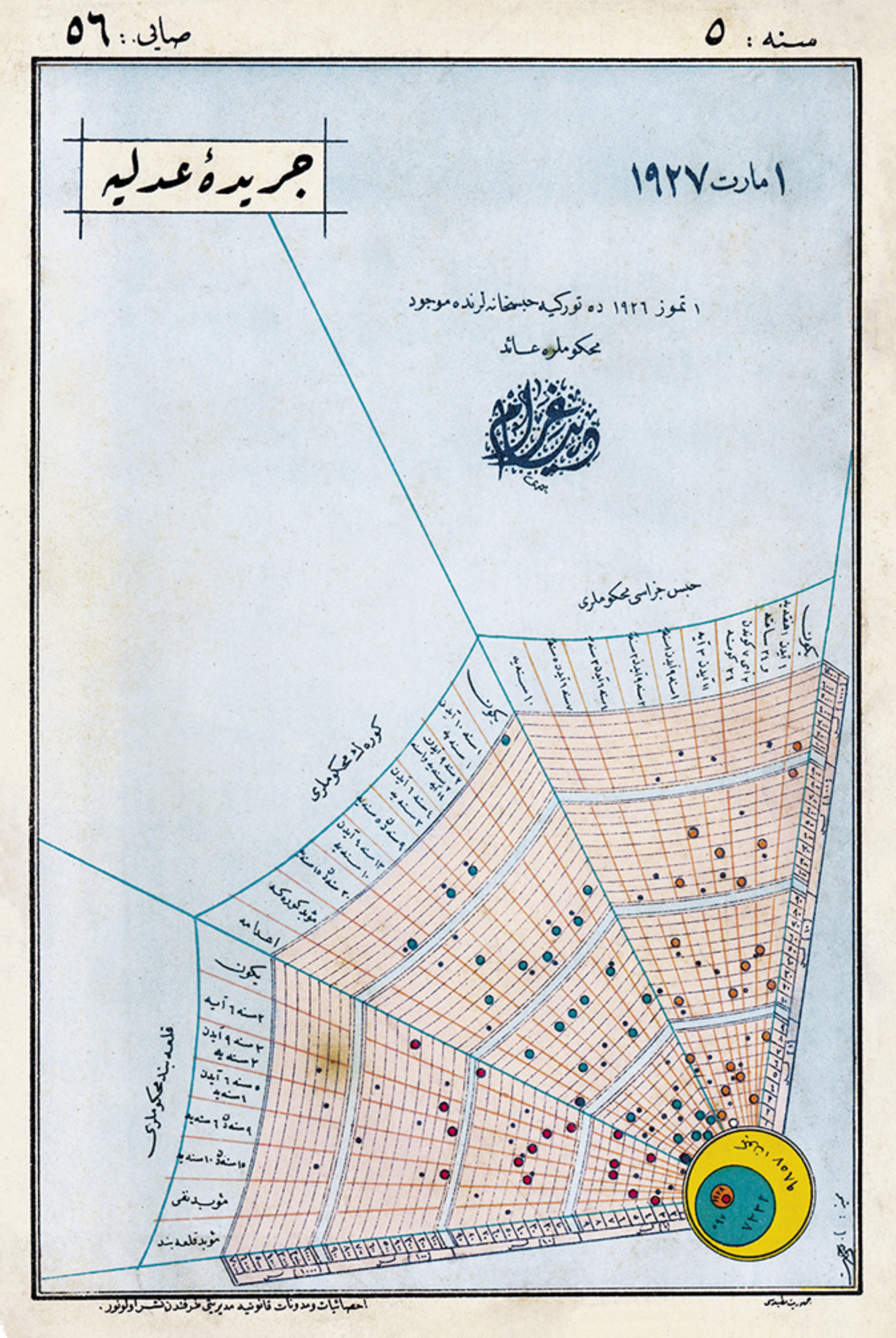
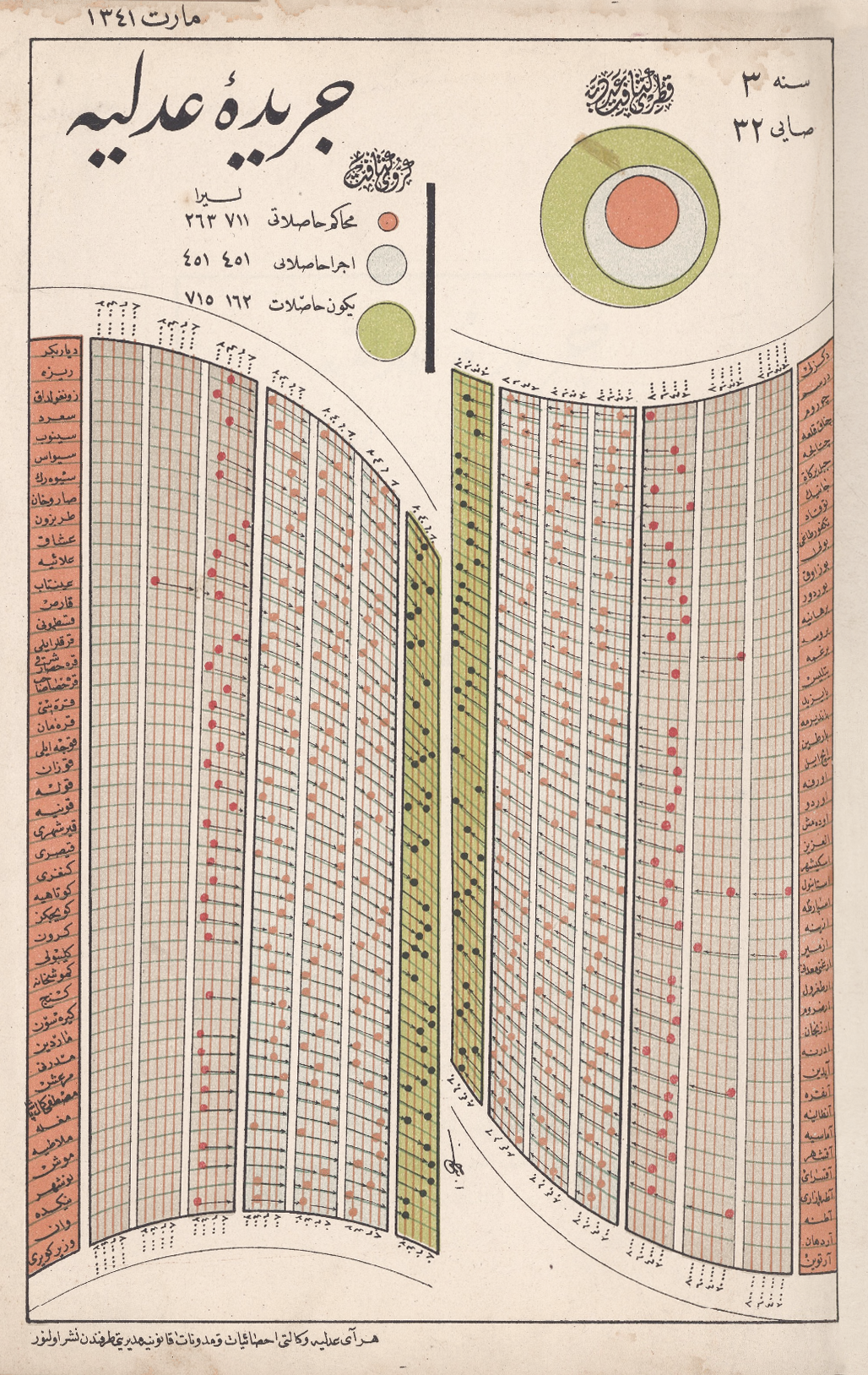
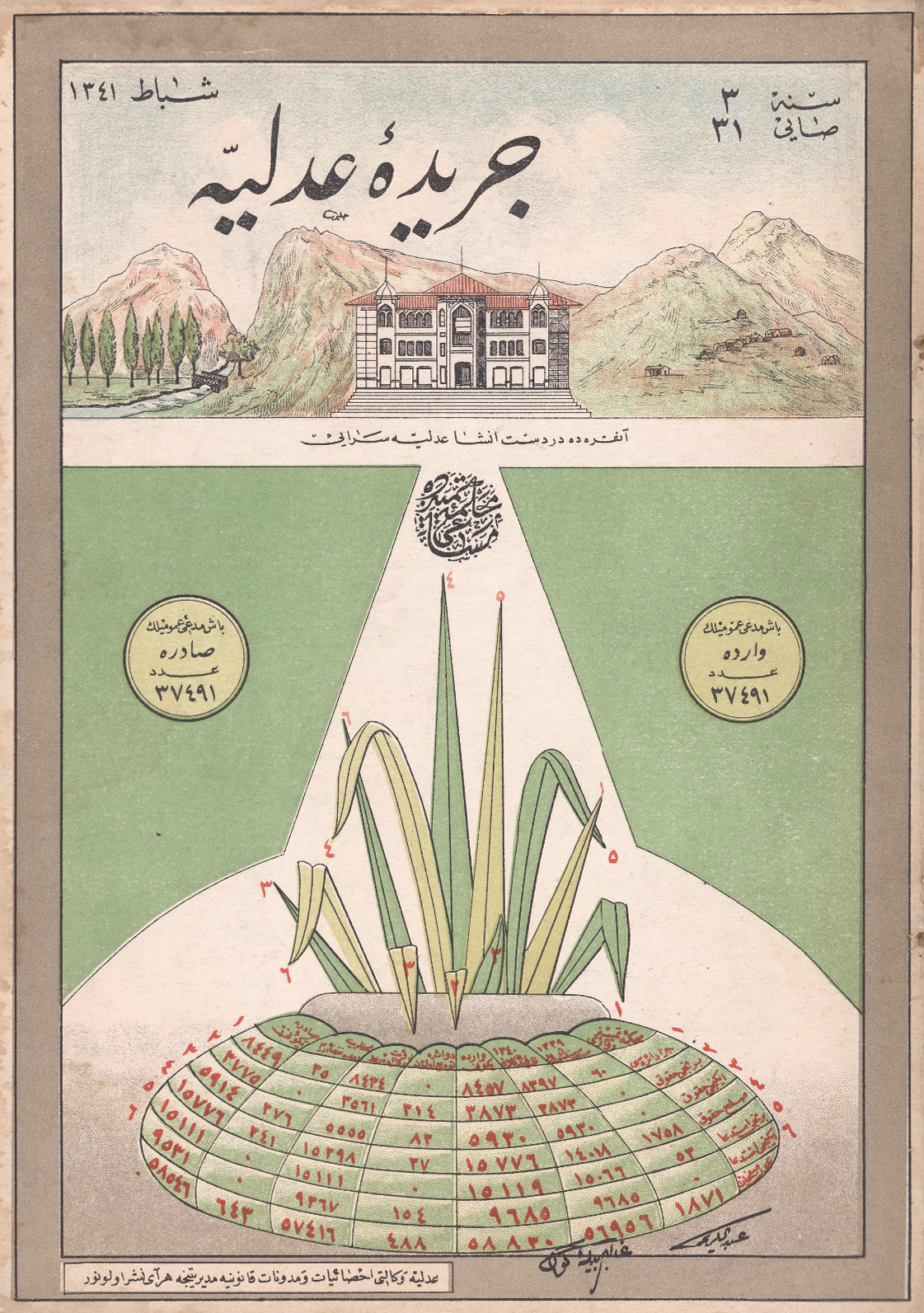
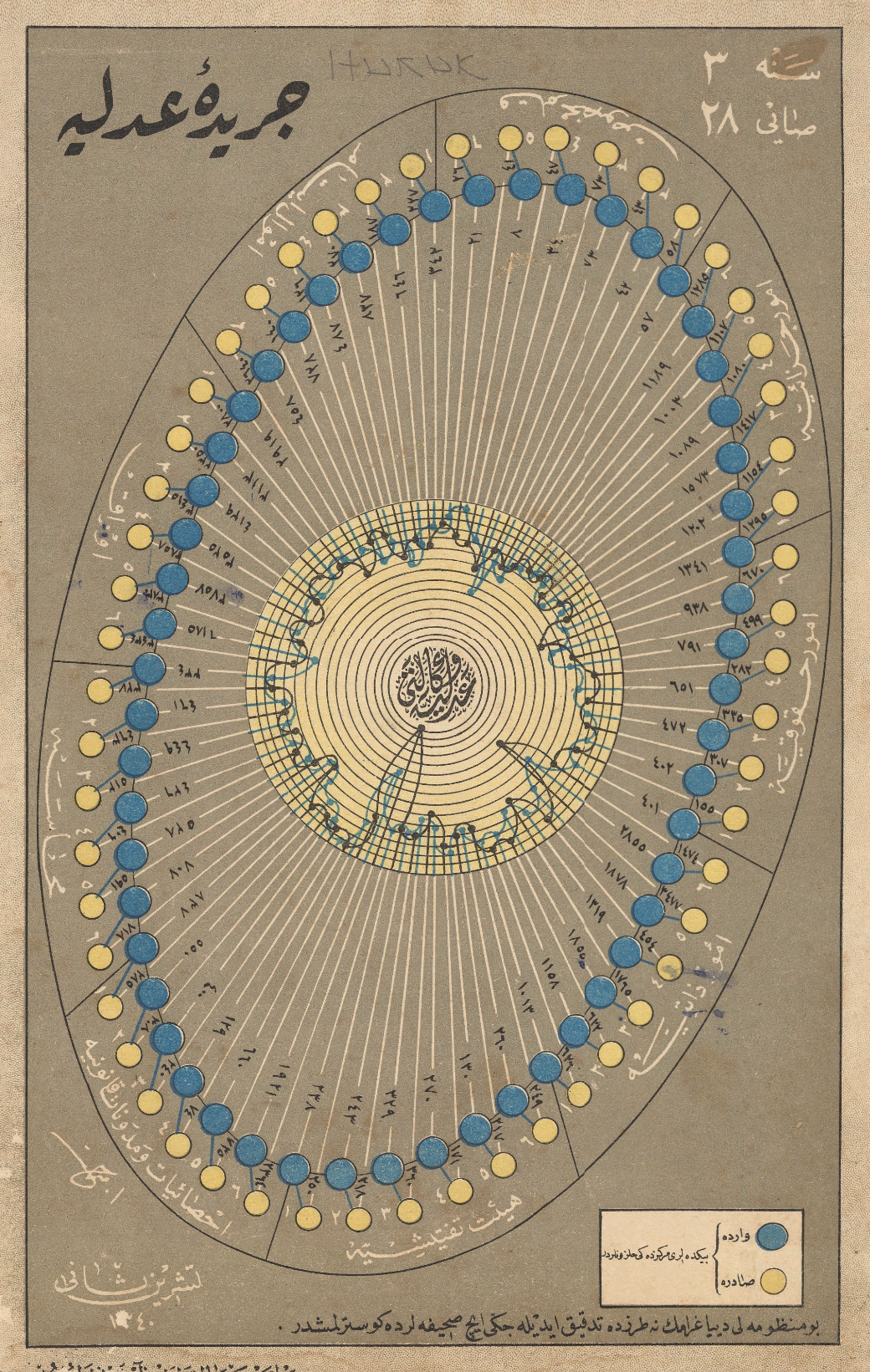
Statistical graphs produced in the early decades of the 20th century in the Ottoman Empire and the early Turkish Republic.
The fundamental weakness of the Muslim world today is that, although it may possess capital, demographics, modern consumption trends, linkages within the global economy—all in different places and in varying capacities—it lacks this process knowledge. Nor have we seriously taken to task that which our ancestors would have considered a matter of course: the adoption and indigenisation of this mode of production to create a truly competitive pole of power. This is the differentiator between those who produce and those who consume, and why no Muslim country has joined the three centres of industrial civilisation as its fourth. We have no systemic theories of how to acquire process knowledge, or how to (re)order state and society around the needs of industrial production. This is largely a failure of imagination, but it is also the result of the ideological straitjacket within which we have bound ourselves. Instead of engaging with material reality, we have become passive consumers who believe our critiques, made from some theoretical external position of moral superiority, will bear fruit in changing this reality. And so the world passes on by us without a care for our thoughts.
The Ideological Roots of Anti-Modernity
Every tendency within the discourse of contemporary Islam has something to say about capitalism, technology, urbanisation, and the moral character of modern work. Yet these opinions operate with categories forged before industrialisation transformed the material basis of human existence. And the intellectual traditions that educated Muslims have borrowed to give their critiques a contemporary flavour are a curious convergence of ideologies that otherwise share little in aspiration.
The first of the borrowed traditions is Catholic reactionism, the counter-Enlightenment current that runs through figures such as Joseph de Maistre, who treated the French Revolution as divine punishment for abandoning the old hierarchical order, or through G.K. Chesterton and Hilaire Belloc, who confronted industrial England with a programme they called distributism. Distributism proposed breaking up concentrated industrial capital into small-scale peasant proprietorship, rehabilitating the pre-industrial guild, the village workshop, and the local economy governed by custom rather than contract. They distrusted the factory as a moral institution and regarded industrialisation itself as an error. Their programme was backwards: restore the small, the local, the pre-industrial, and the moral order would follow. This tradition now circulates, with remarkable fidelity to its European originals, as “authentic Islamic thought” on economics, technology, and urbanisation. One encounters it in the growing literature on Islamic permaculture or in waqf revivalism, which treats a pre-industrial charitable endowment structure as a sufficient institutional technology for the 21st century. The prescription, returning to tradition, is not available to two billion people living inside Industrial Civilisation, consuming its outputs, depending on its infrastructure, and possessing no alternative material basis for their existence.
The second borrowed tradition runs through the work of perennialist philosophers such as René Guénon and the traditionalist school associated with Seyyed Hossein Nasr. Its diagnosis of modernity is civilisational rather than merely economic: the modern world represents a spiritual descent, a progressive evacuation of the sacred from public life, an age of dissolution that traditional metaphysics predicted and that only a return to primordial truth can remedy. This tradition has found a receptive audience among educated Muslims because it confirms a preexisting suspicion that something is deeply wrong with the modern world and offers the dignity of a philosophical framework within which that suspicion can be articulated. Perhaps its most sophisticated Muslim expression is Abdal Hakim Murad’s engagement with Julius Evola’s metaphor of “riding the tiger”. His proposal is that Muslims should neither embrace nor flee modernity but instead adopt a posture of inner spiritual withdrawal while remaining physically present within it. The tiger, in this reading, is someone else’s animal. One holds on. The surface of modern life is conceded as turbulent and spiritually corrosive; the depths, the domain of tawhid and contemplative practice, are where Muslims should invest their real energies. Murad departs from Evola’s pessimism by arguing that Islam possesses the spiritual resources to survive the ride. However, the material domain of production, institutional construction, and political economy is tacitly abandoned. The question of what Muslims build does not arise because the framework has no vocabulary for it.
There is a third tradition, the Frankfurt School and its intellectual descendants: Theodor Adorno, Herbert Marcuse, Max Horkheimer, and the post-colonial theorists who extended their critique to the global periphery. Their argument was both economic and civilisational: industrial capitalism degrades culture, manufactures false consciousness, reduces every human relation to exchange value, and produces a culture industry that pacifies populations through entertainment calibrated to prevent genuine reflection. Post-colonial theory recasts modernity itself as a Western imposition and development as a euphemism for domination. This is the intellectual atmosphere that educated Muslims absorb at university, through media, and through the general texture of serious discourse in the humanities and social sciences. The diagnoses are often correct, yet this tradition is constitutively incapable of construction. It tells us everything that is wrong with industrial civilisation and nothing about how to build within it, because doing so would compromise the critical posture from which its authority derives.
These three traditions are antagonists in their European contexts. Catholic distributists, perennialist metaphysicians, and Frankfurt School critical theorists would find little to agree on. However, as absorbed by the Muslim intelligentsia, they produce the same refusal to adopt a constructive orientation. Each, in turn, offers a posture of return, withdrawal, and critique. None confronts the question facing a civilisation of two billion people living inside industrial civilisation: given that we are here, what do we build?
This steadfast refusal is contradicted at every turn by the practice of those who hold it. The scholar who denounces modernity does so on a podcast distributed via satellite and recorded on equipment manufactured in Shenzhen. The activist who calls for de-industrialisation organises his movement through smartphone networks whose components were mined in the Congo, refined in South Korea, and assembled in China. This is evidence of a civilisation that has made peace with the material outputs of industry yet lacks an intellectual framework for engaging with its logic, trade-offs, or possibilities.
And herein lies the deepest error, for the assumption that spiritual interiority as a total civilisational strategy represents the traditional Islamic position is, in fact, untrue. It is, in historical terms, among the newest responses available, not the oldest. For over a millennium, the operative mode of Islamic civilisation was material engagement at the highest level. The Abbasids built Baghdad as a planned imperial capital and centre of translation, scholarship, and trade. Córdoba under the Umayyads was the largest and most materially advanced city in Europe. The Fatimids founded Cairo and Al-Azhar as instruments of political and intellectual power. The Mughals administered a subcontinent and became the largest empire, in terms of population and production, in history–until the advent of the industrialising British Empire. The Ottomans ran a transcontinental empire whose fiscal, military, and administrative apparatus was among the most sophisticated of its era. It was Islamic civilisation which formed the bridge on which merchants and adventurers brought materials such as paper and gunpowder from China to Europe, not out of idle curiosity, but because these were useful technologies for running empires and waging wars. Trading, warring, building, and governing were what Islamic civilisation did.
The retreat inward was a consequence of the triple catastrophe of the 20th century, which destroyed the material base on which Islamic civilisational activity had rested. In the absence of that base, Muslims retroactively elevated the spiritual-contemplative dimension from one component of a full civilisation to the entire programme. What presents itself as preservation is, in substance, a rationalisation of defeat. Islam possesses spiritual resources adequate to providing a robust moral response within industrial civilisation. The question is whether spiritual resources alone, detached from any material civilisational capacity, constitute a civilisation at all.
Misdirected Energy
These borrowed postures have, downstream, produced a set of enterprises that mistake activity for progress.
Islamic finance operates at the level of consumer products, asking whether a given financial transaction satisfies the conditions of a pre-industrial contract while leaving unasked whether the economy that transaction services is productive, whether the country in question should industrialise, how it should position itself in global trade, or what its energy strategy ought to be. Islamic economics, its academic cousin, adopts neoclassical orthodoxy wholesale, appends a list of prohibitions, and calls the result a moral economy: an economics without a theory of production or development, containing nothing the original framework did not already possess, except for the prohibitions. What Sherman Jackson has diagnosed as sharia maximalism reduces all legitimate Islamic intellectual activity to jurisprudential derivation, contracting a civilisation that once encompassed architecture, medicine, astronomy, philosophy, and statecraft to the domain of legal rulings alone.
Even the more thoughtful attempts at institutional revival betray the limitation. A paper proposes resuscitating the waqf to address structural causes of poverty, including those linked to global agricultural supply chains and racialised wealth gaps. The ambition is commended, but the institutional imagination does not extend beyond the pre-industrial form. It ignores the rich endowment heritage of the modern world, such as the Rockefeller, Carnegie, and Ford foundations that seeded America’s great ecosystem of research universities, hospitals, and policy institutions. Or the Nordic and German corporate-foundation structures, such as Bosch, Wallenberg, and Carlsberg, that created self-sustaining institutional ecosystems compounding knowledge and capital across generations. These are the functional successors to the waqf’s civilisational role, operating with legal, financial, and organisational architectures adequate to industrial scale. A serious Islamic endowment tradition for the 21st century would study these models because they solved the problem the waqf once solved at the scale the 21st century demands. Instead, the conversation begins and ends with the pre-industrial form, as though the institutional technology has not advanced in seven centuries.
And then there is agrarian revivalism, whose most visible contemporary manifestation is the growing Muslim permaculture movement, which proposes small-scale organic farming as an alternative to industrial agriculture. Zaytuna College, an Islamic liberal arts college in California, has established a permaculture centre whose stated mission is to help Muslims “get back to more natural ways of producing food” and to “explain the flaws and destructiveness of current systems of production.” A nine-acre garden in the Berkeley Hills, growing olives, figs, and seasonal vegetables for a college community, is offered as a replicable model for the ummah. There is nothing wrong with eating seasonally, tending a garden, or caring about what goes into one’s body. These are admirable habits. However, presenting permaculture as a civilisational programme, an alternative system of production for two billion people, requires a reckoning with some very stark numbers. That world of natural food production did exist, and it was one where famine and plague abounded, and infant mortality and life expectancy were roughly half of what the Industrial System now provides.
Each of these—Islamic finance and economics, the charitable endowment, and agrarianism—will be explored in more detail in future essays. For now, this suffices as an introduction to the problems that these initiatives face at the outset.
The Only Way Out is Through
Most of the problems confronting Muslim civilisation are problems of political economy. Thus, we return to Ilm al-Umran. Ibn Khaldun’s science of civilisation was, in its 14th-century form, a theory of how political communities form, cohere, extract surplus, and decline. This science requires updating to meet the demands of the industrial age by creating new material theories of civilisational capacity.
This should not be confused with reductive materialism. It is the observation, consistent with Ibn Khaldun’s own method, that material conditions are the foundation on which everything else rests. The problems are the absence of indigenous technological capacity, the failure to move up global value chains, the dependence on manufactured imports, and the inability to sustain independent centres of knowledge production. These are problems of production, process knowledge, and the institutional infrastructure through which surplus is generated and directed toward further productive investment. Once productive capacity exists and the process knowledge that sustains it has been acquired, the remaining questions, spiritual, philosophical, and theological, become open in ways they cannot be when the civilisation that asks them possesses no material basis for acting on the answers. A philosophy of technology produced by a civilisation that manufactures nothing is at best ornamental. A philosophy of technology produced by a civilisation that builds semiconductor designs the present and future.
The new science asks different questions from those that currently dominate Islamic intellectual life. This requires naming reality accurately rather than describing it in categories inherited from a world that no longer exists. This means building methodologies and feedback loops that connect theory and practice, the scholar and the factory floor, and the economist and the engineer. It also requires the discipline of production through the accumulation of process knowledge, which compounds only when practised, not merely theorised.
Three nodes of industrial civilisation exist today. There could be a fourth, albeit it will not emerge from mere exegesis of Ibn Khaldun, further elaboration of sharia-compliant financial instruments, pastoral romanticism about the pre-industrial world, or from the sophisticated diagnosis of everything wrong with the industrial one. It will emerge through the generational accumulation of process knowledge as we engage with the world around us.
Islam possesses within it the resources to anchor a new world of ideals and possibilities. Those who come to understand, iterate, and design the system on their own terms determine its moral arc. If we have a choice between riding the tiger and hoping we hang on, or allowing it to trample us with complete passivity, I offer a third option for your consideration: mastering the tiger. After all, what is this tiger, this epoch defined by the industrial mode of production, but a mechanism fashioned by men? The strongest hands steer it.
The only way out is through.
Words: Ahmed Askary is Editor-in-Chief of Kasurian.