

What Are Podcasts For, Anyway?
Between a duet with a nightingale and a sensationalist thumbnail, Sohaira Siddiqui and More Muslim attempt to restore audio to an art form.
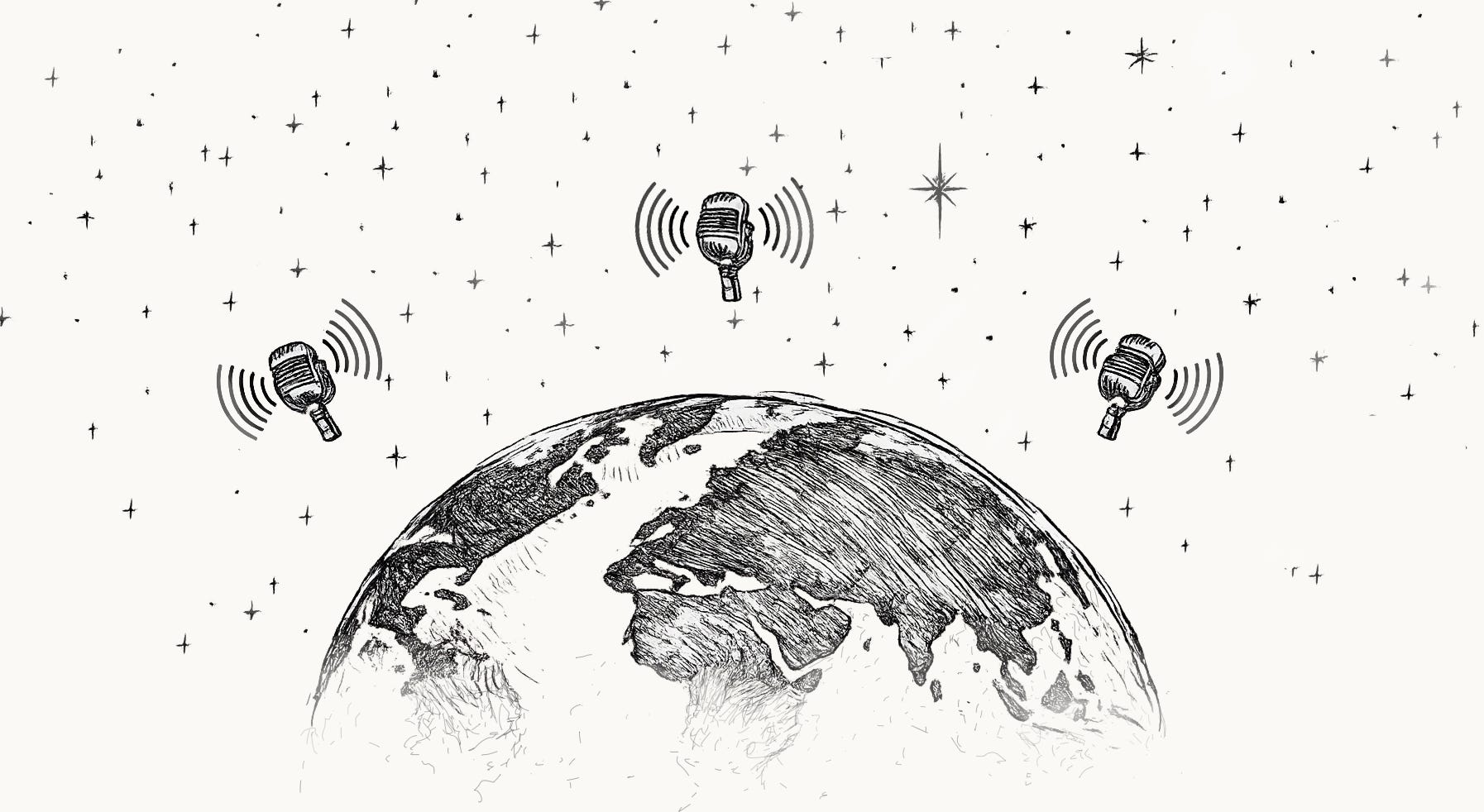
“Sound itself attracts, ask an eavesdropper. Sound is the first stirring of the infant. He hears sounds, he puts them together and they cohere. Sounds have a romance... the vibration of air creates sound, and radio was a medium which employed that magic.”
—Norman Corwin, Empire of the Air
“There are these two young fish swimming along, and they happen to meet an older fish swimming the other way, who nods at them and says, ‘Morning, boys. How’s the water?’ And the two young fish swim on for a bit, and then eventually one of them looks over at the other and goes, ‘What the hell is water?’”
—David Foster Wallace, “This Is Water,” Kenyon College Commencement Address, 2005
The Cello and the Nightingale
On April 23, 1924, the 18-month-old BBC, still under strict news-broadcasting rules designed to protect newspaper sales, broadcast a speech by King George V to an estimated 10 million listeners. A month later, it was crouched in a ditch in a wooded garden 20 miles south of London, waiting for a bird to sing. On that late spring night, a nightingale sang along with Beatrice Harrison and her cello. Broadcast live to a million listeners and heard as far away as Paris, the performance changed radio history. “It was something,” Harrison wrote in her autobiography, “to see all the paraphernalia of the BBC in our garden. It was a great risk, of course, as in those days, no wild bird had been broadcast in its natural state. It was a thing so new that they all, engineers included, seemed to think it impossible.”
What made the nightingale broadcast possible and what, in many ways, changed the trajectory of audio media, was a single new piece of equipment commissioned by then-embryonic and still privately owned BBC: the Marconi-Sykes magnetophone. The magnetophone, nicknamed the “meat safe” by the engineers who had to move it around, was, by any measure, an absurd, almost comical piece of equipment. It weighed 20 pounds, required a bank of batteries to operate, and was so mechanically fragile (its sensing coil was made of hair-thin aluminium wire, dampened with cotton wool and Vaseline) that a firm footstep nearby could knock it out of commission. On May 19, 1924, this fussy piece of equipment, normally kept inside a copper mesh cage to protect it from interference, was taken outside.
Outside, the Marconi-Sykes magnetophone expanded space. “When people listened to the radio before the Beatrice broadcast,” says Dr. Kate Kennedy, a cellist, academic, director of the Oxford Centre for Life-Writing and the General Manager of the Museum of Music History, “everything sounded very flat, very claustrophobic—there’s no sense of space. So, as a medium for the arts, as a medium of creativity, it wasn’t really going anywhere. It was like having a walkie-talkie.” Where earlier microphones flattened what they captured, this one created depth, capturing the difference between near and far, between a cello string, a leafy rustle, and a nightingale’s song. For Jonathan Sterne, whose The Audible Past: Cultural Origins of Sound Reproduction, traces how every new sound technology reshapes what its listeners are capable of hearing, this distinction — between the walkie-talkie, and depth — is crucial because it changed what listeners were trained to do with their ears, placing them, texturally, inside a space they could not see. The nightingale broadcast was, therefore, Dr. Kennedy notes, the moment radio became visible, or, if you will, audible, as a form. It “opened the door to the possibility of recording with depth,” and it made the listener feel like they were somewhere.
That night, the precarious BBC, at the cutting-edge of radio’s magical possibilities, discovered what audio, as a medium, could be, and what it could do. Its discovery, that presence, intimacy, and the sense of being transported elsewhere could be manufactured through sound alone, would go on to define the ambitions of audio storytelling for the next century. Yet, the question the nightingale broadcast asked, perhaps unwittingly in 1924, what is audio actually for, and what can it do, is, in the evening twilight of mass literacy, in the time of the “clip economy” and the vestigial podcast, more alive than ever.
The Intimacy of Audio Over Time
In the century since Harrison’s duet with the nightingale, audio, as a form, has followed a trajectory more in common with the newspapers it was once feared it would put out of business. Like all novel technologies, early radio was met with handwringing. In the 1935 book, The Psychology of Radio, authors Gordon Allport and Hadley Cantril reflect on the then-nascent, 10-year history of radio, declaring that while the romantic soul might be thrilled by its wonders, the “reflective soul” surveys its rapid growth “with a feeling of helplessness and dismay.” They know that radio is a “technological advance” of the first magnitude, a “revolution in communication,” a “gigantic tribute to human enterprise,” but that it is also an “agency of incalculable power for controlling the actions of men.” “We realise we cannot be far off,” they continue, “when men in every country of the globe will be able to listen at one time to the persuasions or commands of some wizard seated in a central palace of broadcasting, possessed of a power more fantastic than that of Aladdin.”
Allport and Cantril’s concerns would be familiar to readers today: the standardisation of taste and thought because radio must cater to an average; the threat to literature if people listened so much they no longer needed novels; the susceptibility of listeners to propaganda; the erosion of civic life; the penetration of the home by a disembodied voice; the corruption of children’s habits of attention, their capacity for sustained reading and their moral formation.
While Allport and Cantril’s findings were not ultimately conclusive—confirming some fears, and complicating others—their early recognition that radio, that the disembodied voice, that audio itself as a form, was reshaping people’s psychology, intellect, and homes, was astute. As Paddy Scannell would later write in Radio, Television and Modern Life, broadcasting had accomplished something historically unprecedented: it mediated daily and routinely between the public world of events, and the private world of the home, giving millions of people a structured sense of shared time and experience, a common horizon of expectation, a feeling of living in the same present as everyone else.
The podcast—famously, a portmanteau of “iPod” and “broadcast,” because the first podcasts were designed to be downloaded from an RSS feed onto the iPod and listened to on the move—arrived in 2004 as a form that simultaneously inherited and ruptured what audio media, primarily radio, had been until that moment. It inherited radio’s intimacy, the disembodied voice, and the private listener, while simultaneously rupturing the shared present that had given that intimacy a public, and even civic, dimension. What radio may have done to national public life and the “imagined community,” podcasting did to micro-communities and potentially the individual self. As Martin Spinelli and Lance Dann argue in Podcasting: The Audio Media Revolution, where radio entered the room, the podcast entered the ear. The disembodied voice did not cross a distance to the listener; it was inside them.
Ironically, podcasting reached a zenith by remixing the public radio tradition—This American Life, 99% Invisible, Serial, Radiolab, and the “Golden Age of Podcasts”—and showed, briefly but perhaps brilliantly, what contemporary audio, as a distinct media form, was capable of. These podcasts, defined by a highly produced, cinematic, audio-only storytelling that prioritised deep-dive investigative journalism, immersive soundscapes, intimate narration, and intentional, even heavy-handed and self-aware editing, were designed strictly for the intimacy of the earbud. They were characterised by sophisticated audio and sound engineering, with ambient sounds—the crunching of gravel, the ringing of phones, the murmur of a coffee shop, the scratch of a pencil on paper, the chime of a hospital monitor—that placed the listener inside a physical world they could not see.
Radiolab, under Jad Abumrad, refined this method, treating sound “sculpturally,” by drawing on film editing and avant-garde music. This symphonic editing style defines the medium. We hear it in Ira Glass’s bashful stammering layered beneath an atmospheric score, and in Roman Mars’s even-keeled voice framed by dramatic pauses. For Abumrad, this editing style was philosophical. He viewed Radiolab’s job as being “the people who struggle to hold both,” or those who seek to maintain competing truths in productive tension, rather than forcing a resolution. It was an editing style designed to train listeners to hold complexity, ambiguity, and unresolved tension at the same time.
The golden age of podcasts carved out an audio form that used storytelling to pose questions and invited listeners into a process of curiosity and discovery, rather than delivering neatly packaged answers. While Brace Belden, co-host of a podcast generating roughly $200,000 in monthly revenue, is right that this era of podcasts, what he terms the “Obama backwash,” of shows that let “listeners pretend they are learning something,” had a distinct flavour of liberal self-satisfaction, the tradition ultimately represented a genuine exploration of what audio as a form could be.
Over the past decade, the long-form, personality and host-driven podcast, and with it, the “vodcast,” has become the medium’s dominant form: a Covid and Biden-era shift that Belden describes as producing “cartoonish hangout sessions with the worst every gender has to offer.” The vodcast is built, to some extent, on the cultivation of a parasocial relationship between listener and host—a dynamic it shares with streaming as the two increasingly converge—where hours of unstructured “hangout” simulate or substitute for knowledge and intimacy.
The clip economy extended this logic: snippets from the long conversation or interview, extracted into a provocative or evocative flash of reaction without cause. The vodcast clip is the anti-narrative. Seemingly indistinguishable in length from an advertisement, the clip precludes reflection, ambiguity or tension. Intellectually and psychologically, as a form, it reduces the texture of conversation, of thought itself, into a vacant, anachronistic hum. It creates an information diet in which knowledge becomes the hook of a pop song, familiar and pleasing, but ultimately, cognitively stunted. Over time, it degrades the ability to coherently follow or challenge, let alone express, a linear and rigorous argument.
While the causes for the shift from podcast to vodcast to clips are varied and worth understanding, especially the economics of algorithms and YouTube, today’s podcast ecosystem actualises some of Allport and Cantril’s fears: It serves the lowest common denominator.
The Muslim Podcast Ecosystem & Its Discontents
Nowhere is this phenomenon more acute than in the Muslim podcast ecosystem, which broadly divides into two categories: (1) the motivational and devotional mode, which includes Islamic lectures, business/entrepreneurship, and testimony-driven storytelling, and (2) the current affairs mode, which includes podcasts on geopolitics, history, philosophy, polemics, da’wah, and worldview “correction.” The first counts among its practitioners the likes of the Qalam Institute, Yaqeen Institute, and various Imam-led podcasts; the second counts, among others, the Safina Society, Ansari, Thinking Muslim, OnePath, Blogging Theology, and sometimes Yaqeen Institute podcasts. There are, of course, many not included here, and similarly, among those listed, varying levels of sophistication, substance and intellectual rigour. Yet, despite each serving a valid purpose that resonates with audiences, the totality of the most widely available options leaves something to be desired.
For example, among those which are vodcasts, nearly all are marked by the Mr. Beast school of thumbnail and title design, in which every episode promises a conspiratorial bombshell, a breaking point, or a takedown.
“WILL MILO ENTER ISLAM?” “STRANGE JEWISH PROPHECY, PALANTIR, AI & THE MESSIAH” “IS IRAN OUTPLAYING AMERICA?” “THE WAR ON OUR CHILDREN” “THE 1,000 YEAR PLAN THAT DEVOURED THE MUSLIM WORLD,” “EPSTEIN IS A SYMPTOM” “HAS HAJJ BECOME TOO EASY?”
All similarly participate in the clip economy. Even ‘The Thinking Muslim’, which presents itself as a serious intellectual podcast and has occasionally produced genuinely captivating conversations, titles its episodes with grievance or urgency-theatre bait. Regardless of substance or quality, the result is cheap.
At a more fundamental level, what generally—though not always—unites these podcasts is that they are all declarative rather than interrogative. The answer largely precedes the question, and the argument is a spectacle for a predetermined conclusion. The listener is, in that sense, both served and shortchanged: he is condescended to in the manner of a toddler, given what he wants (an easy answer), and confirmed in what he already believes, while simultaneously flattered, his sense of himself as a serious, informed thinker rewarded with little asked in return. Outside of the testimony-driven podcasts, the transaction is the same across the board, reproducing a single intellectual culture in which authority always flows in one direction, questions are conclusions in disguise, and the listener’s job is simply to receive, rather than think or sit with ambiguity. The cumulative effect is an education that forecloses curiosity and, by extension, the rigour that true learning requires. Over time, this form inhibits the ability and capacity to produce productive knowledge at all.
It is into this pernicious ecosystem that ‘More Muslim’, a new podcast produced by alums of the golden age of podcasts, and hosted by Islamic scholar, Georgetown professor, and founding director of Mujadilah, a women’s mosque and intellectual institution in Doha, that Dr. Sohaira Siddiqui arrives.
What is Water?
I meet Dr. Siddiqui over video—she takes the video call outside, under the Ramadan night sky— just over a week after Qatar Energy has declared force majeure after Iranian strikes on Ras Laffan. Self-described as a wallflower, she has a warm American approachability, and an unhurried but precise and self-possessed authority. We are meeting to discuss More Muslim, but the conversation goes all over the place, which is another way of saying a conversation that connects everything back up.
More Muslim, she explains, derives its name from the mubah, the “permissible, gray area, the messy middle” that most Muslims, as she describes, “are quietly muddling through,” but also from a joke: a play on the seriousness with which Muslims should always be elevating themselves and their faith, and “the cheekiness” by which sometimes “our debates become unidimensional.”
The origin of the podcast began with a small group of graduate students, who, in one of those propitious moments in life, found, in Dr. Siddiqui and in each other, a shared vocabulary. Gathering at Dr. Siddiqui’s house, the group of “podcast nerds,” created a space together that they felt was missing elsewhere in the Muslim landscape. Dr. Siddiqui, who is Islamically trained, jokes about those conversations: “I’m not giving fatwas,” she would say, “we’re all just here to discuss the issues.” The posture of those gatherings—rigorous, open-ended, but comfortable without neat resolution—eventually became More Muslim.
As a podcast, More Muslim is, first and foremost, a masterpiece of audio as a distinct form. Expertly edited and textured, it is sonically immersive and cinematic. It is not a podcast for passive listening. It travels the world and, as a reporter-driven, not host-driven podcast, is a departure from the dominant Muslim audio format.
Crucially, unlike the prevailing form of podcasting today, More Muslim trusts its listeners and, by expecting more of them, empowers them. Each episode opens with a question that does not neatly close, inviting the listener to generate her own takeaways and to sit with what is unresolved. Its spirit embodies a canny teacher who, by expecting more of you, will inevitably draw more out of you. By doing so, it succeeds at something the dominant form generally cannot: it creates a new intellectual register.
For Dr. Siddiqui, the “intellectual” is deeply personal. Describing her first encounter with the scope of the Islamic intellectual tradition at the University of Washington as a still-then STEM undergraduate student, pulling book after book off the shelf—medicine, art, architecture, philosophy, law—“I never understood the vastness of it.” “This isn’t an intellectual tradition,” she said, “it’s a world.”
And yet, today, that vast Islamic intellectual world has narrowed. The “legal space,” Dr. Siddiqui says, “takes up a disproportionate amount of time and conversation and energy.” To her, the danger lies not only in how this framework informs the present but also in how it informs the past. If the “way in which you’re actually understanding your Islamic past is also legal,” she notes, that is, “for me, where …you have an intellectual closing.”
Her diagnosis is clear-eyed and precise: “the intellectual narrowing,” by which she means a legal-centric framework, the “historical narrowing,” related, in part, to the legal-centric framework, and the “geographical narrowing,” by which she means the dominance of Arab, and secondarily, the South Asian, experience in mainstream Muslim discourse, at the expense of Africa and Far East Asia, is, to put it simply, “problematic.”
This intellectual, historical and geographical narrowing, she argues, is the result of the colonial project, which was not only political and economic, but “epistemological and intellectual.” It removed Islam from all spheres, with the exception of personal status law (effectively, family law), and, for example, dismantled the curriculum of the Mughal madrasa, which once taught logic, philosophy, art, poetry, and theology, replacing it with Arabic and law. Today, scholars like Sherman Jackson and, in a different register, Abdal Hakim Murad, have tried to put words to recover what was lost. The Islamic Secular is precisely an attempt to reclaim the vast non-legal space of Muslim intellectual life that the colonial project foreclosed. But, Dr. Siddiqui notes, “the number of Muslims that are going to sit there and read Sherman Jackson’s book, or read my book, is a very limited number.” The issue then becomes, she says, “one of translation.”
“We have to shift the normative discourse of Muslims,” she says, reaching for David Foster Wallace’s fish vignette—the two fish who do not know they’re in water. Part of the problem is that Muslims don’t see the water: the colonial restrictions that have so thoroughly shaped the intellectual framework that they are invisible from inside it. But, she notes, “we can’t overly intellectualise this issue,” or else you’ll lose people. Meaning, the normative space, she continues, “has to be one in which we find the language that everyday Muslims can get behind.”
For Dr. Siddiqui, this means meeting people on the road they’re on. “If one looks at how many people listen to someone like Imam Omar Suleiman or Nouman Ali Khan,” she says, “you realise what they’re doing is motivational speaking, but that’s what people are relating to.” To pierce the normative discourse, “you have to figure out a way to make this intellectually sophisticated argument in a way that people actually listen. And that’s what we haven’t figured out yet.”
The Story of the Beautiful Building
More Muslim is her and her producers’ attempt at figuring it out. For now, that answer is storytelling. “Instead of me sitting here and telling you a very complex history about how a madrasa was transformed into a colonial university,” she says, “I can simply tell you the story of this beautiful building.” What is its story, how did it come to be, who built it, and inhabited it, and how has it changed over time?
She acknowledges that a podcast like More Muslim doesn’t exist for the Muslim community. After all, it demands a type of consumption that’s fallen out of style. “We don’t want passive listeners,” she says, “we wanted people to really think along with us, and feel the struggle of the reporter, to feel what the question is like.” This posture is better oriented towards knowing that we are in the water. “The law is spiritually comforting,” she says, but “to move into the messiness, to move into the mubah, to move into that middle space, is much more difficult. It requires us to be a lot more conscious.”
The first season makes good on that promise. Despite often struggling to listen to podcasts, I found myself, episode after episode, genuinely surprised, moved, and inspired. Not necessarily or always by the subjects, which will be familiar to many Muslims—mosque entrances, the nikkah, Qur’an translation, chatbots—but because each episode deepens something we take for granted, revealing it to be more interesting, more contested, and more human than before. For even the most voracious reader, there is something new to learn in each episode, even if it is from paying attention to how the story is choreographed and told. More than anything, each episode models a form of inquiry and answer-seeking that is largely absent from the available Muslim podcast menu. Each episode shows, and never tells. By showing, one hopes the listener learns not only new facts, but also how to seek.
For Dr. Siddiqui, making the podcast has sharpened the scale of what normative Muslim discourse has missed. One of the most surprising parts of making More Muslim, “was just how much of the richness of the Muslim experience we as a community have not captured.” Sitting with hours of tape, listening to voices that have generally not been platformed, and stories that have never been told, is humbling. “It’s one thing to be philosophically committed to opening the space,” but it’s another to actually “listen to the voices” that occupy that space. She and her producer can only greenlight ten episodes this season, but there are so many more. “There [is] a real sadness to that,” she says, “We’re just a drop in the bucket.”
And yet, More Muslim is in many ways, she says, “a leap of faith,” even though its Muslim audience, so accustomed to the declarative form, might have to be co-created. For Muslims, who choose from podcasts that are often sensational and epistemically stunting, More Muslim is a sophisticated intervention. Most crucially, though, it represents the peak of what audio as a form can be not only for Muslims, but for anyone interested in tightly told stories that leave you with an expanded sense of the world, others, and yourself.
The 1924 BBC broadcast of Beatrice Harrison’s duet with the nightingale was a listening-education event: It taught listeners a new mode of auditory attention and expanded the horizon of what audio could be. More Muslim, responding to its own context, is trying to teach another. How to sit with questions in a way the dominant form has foreclosed — how to ask questions in the first place — and to inhabit and carry forward unresolved endings. The bet is that stories, told sonically with sophistication, patience and care, will, over time, help Muslims answer the question: what the hell is water?
Author: Mariam Mahmoud is a lawyer in California.
Artist: All art has been hand-drawn for Kasurian by Ahmet Faruk Yilmaz. You can find him on Instagram and Twitter/X.
Socials: Follow Kasurian on Substack Notes, Instagram, and Twitter/X for the latest updates.


