

The Rise and Fall of New Atheism
Where did the New Atheists go? A story on the life and death of one of the first internet-driven cultural movements.
In June 2011, at the Alexander Hotel in Dublin, Ireland, the World Atheist Convention was underway. Tickets were sold out, and the stage hosted some of the most prominent atheist voices of the time: Richard Dawkins, PZ Myers, Dan Barker, and Maryam Namazie, among others. Dawkins sat in his olive-green coat and crocodile-duck-imprinted tie, making the case to a captivated audience about the ills of religion and the inevitability of science and reason. The mood was confident.
As the evening progressed, however, a shadow grew over the convention. Rebecca Watson, a participant and YouTuber, posted a video in which she mentioned that a man had followed her into a hotel elevator in the early hours of the morning and propositioned her. Her tone was closer to weariness than outrage. She said, almost in passing: “Guys, don’t do that.” The response was not as passive. Forum threads swelled into the thousands, and blog posts spawned counter-posts. The incident was dubbed “Elevatorgate.” And then Dawkins, in typical flippant and provocative fashion, responded with a sarcastic open letter addressed to a fictitious Muslim woman, titled “Dear Muslima,” itemising the graver oppressions she supposedly endured under Islamic law—the clear implication being that Watson’s grievance did not merit a great deal of attention.
Watson’s request was modest, and yet one of the New Atheist movement’s most celebrated voices had responded by trivialising her experience. The self-styled guild of reason found itself in a quagmire whose fault lines would only continue to grow. Beneath the surface of discursive wars raging around God, unbelief, and reason, another story was reaching its climax.
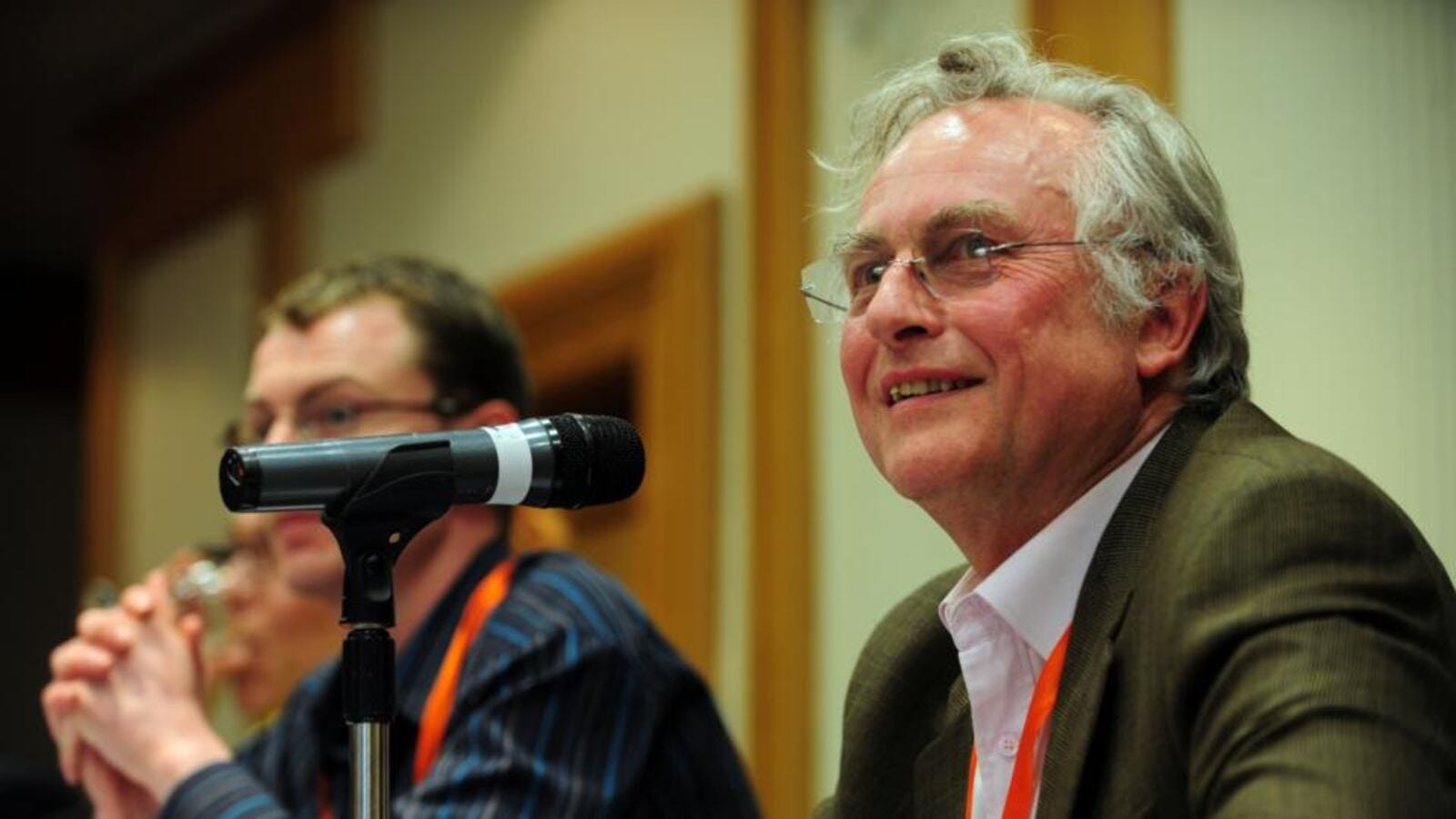
New Atheism had reached a cultural inflection point in the first decade of the 21st century. Three of the West’s load-bearing institutions—the Church, the state, and the market—had each found themselves discredited through scandal and failure. Then the internet arrived, enabling movements to scale at previously unseen speeds. New Atheism was one of the first movements to harness the power and wrath of the early internet, spreading through digital media, forum posting, and YouTube vlogging. Yet the very source of New Atheism’s growth, and the cultural and political milieu in which it succeeded, would later become the reason for its fracturing and downfall.
At the movement’s heart was a remarkable network of ideologues, funders, and internet posters whose deeper connections with one another did not surface until recently, with the release of the Epstein files. In 2026, we have a much clearer picture of the story, which raises concerning questions about the relationship between reason, scientific authority, and power.
The rise and fall of New Atheism is also the story of the first internet-driven culture war, and the innovations they made in the 2000s would later become the playbook which other internet-driven movements would scale to success.
To understand the rise of this movement and its use of reason against faith, it needed a casus belli. That came at the dawn of the 21st century.
Ignition
On the morning of September 11, 2001, under an unbroken blue sky, two Boeing 767s flew into the World Trade Centre in New York City, a third aircraft struck the Pentagon in Washington D.C., and a fourth came down in a field in Pennsylvania. Four hijacked airliners, simultaneously commandeered over American airspace, had struck the heart of the United States. Outrage galvanised the American public, triggering an immune-like response that would launch the War on Terror and the invasions of Afghanistan (2001) and Iraq (2003).
At the heart of the War on Terror was a narrative about faith: to what extent had religion, and in particular, Islam, been a motivating factor for the 9/11 attacks against the United States, and terrorism and war more broadly? As debate intensified, New Atheism emerged in this milieu as the vanguard of the intellectual and cultural war against religion.
The vacuum that New Atheism sought to fill was not only intellectual or emotional. The West was undergoing an institutional crisis. In January 2002, the Boston Globe published its Spotlight investigation into the Catholic Church’s systematic concealment of child abuse, and the first institutional pillar fell. The following year, the intelligence dossiers that had justified the invasion of Iraq were shown to be false, and the second pillar fell. The financial crisis of 2008 would bring down the third pillar, the market, and its claim to efficiency. Trust in American institutions, which had spiked to a 40-year high in the month after the towers came down, collapsed and would never recover.
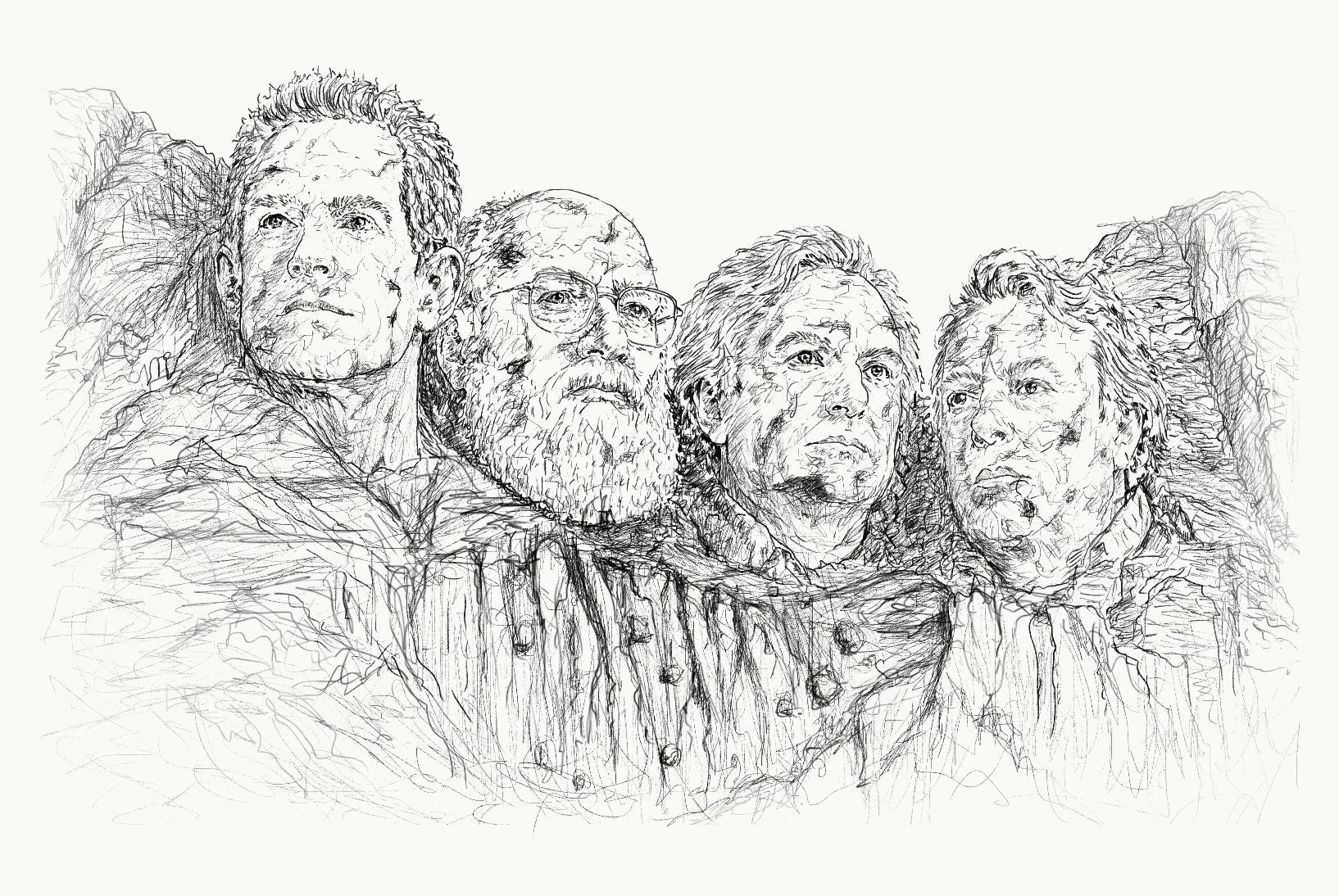
Into that widening institutional deficit stepped the ‘four horsemen’ of New Atheism, armed with books, podcasts, and forums, backed by an infrastructure that had not existed five years earlier.
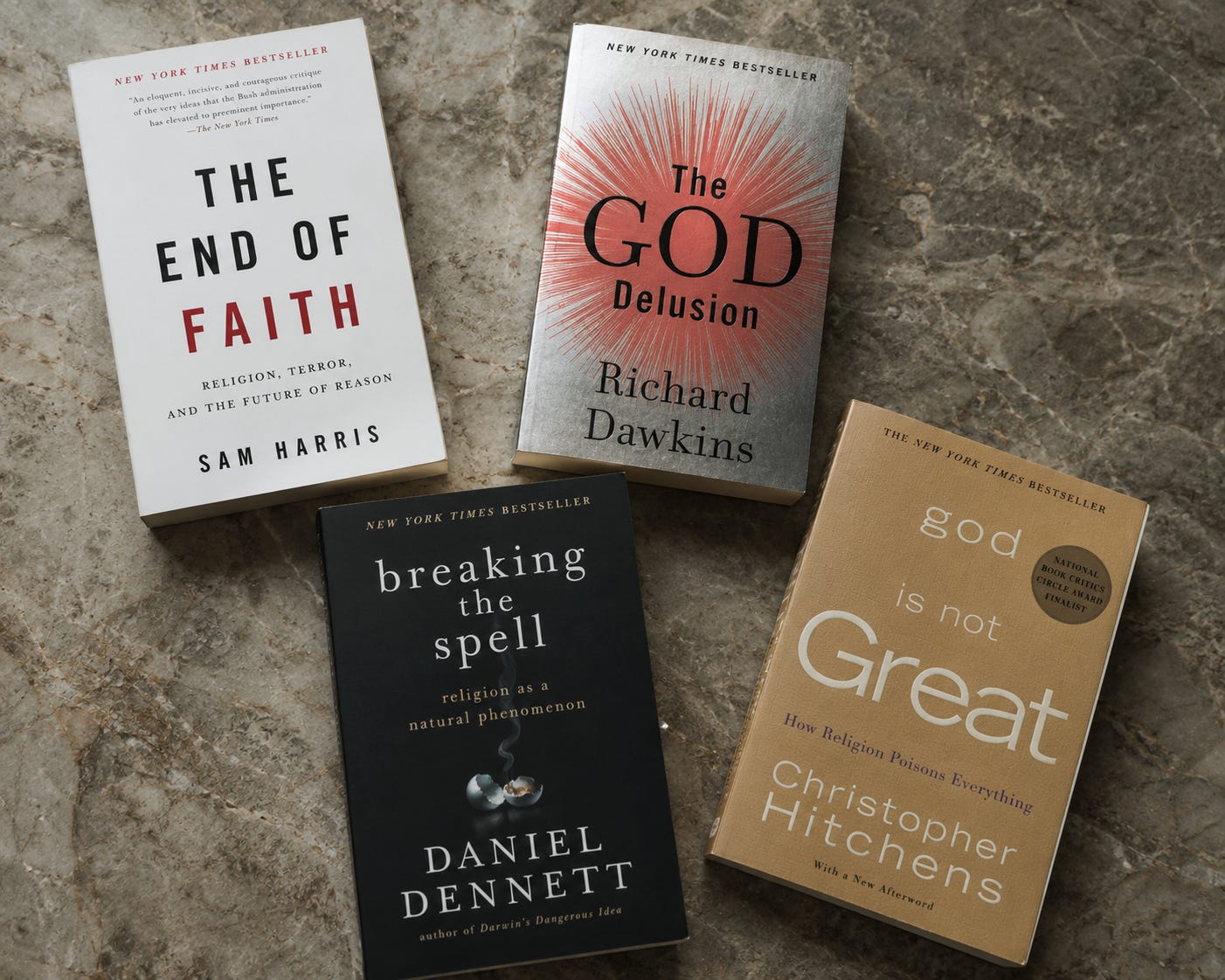
Of the four horsemen, Sam Harris launched the opening salvo of the movement. Sam Harris, a young neuroscientist, dark-haired and clean-shaven, with a flat clinical voice that sounded less like a polemicist than a doctor delivering a diagnosis. In California, Harris was still a graduate student in neuroscience when he began writing a book on September 12, 2001. He was then unknown, unpublished, and in his mid-thirties. Three years later, in 2004, that book appeared as The End of Faith, a work that was declarative, zealous, and unashamedly willing to generalise from religious violence to normative religious doctrine.
In 2006, Richard Dawkins published The God Delusion, which would go on to sell more than three million copies in English and be translated into over 30 languages. Dawkins was ruthless in his attack, describing the God of the Old Testament as, with characteristic relish, “arguably the most unpleasant character in all fiction.” Dawkins was then an Oxford evolutionary biologist in his sixties, the author of The Selfish Gene and the father of meme theory, silver-haired and donnish, and unapologetic in tone. By 1976, he had already made his name defending Darwinian gradualism against its critics on the academic left.
Daniel Dennett’s Breaking the Spell, also published in 2006, was the most subtle, carefully naturalising religion as an artefact of our evolutionary history. Dennett was a philosopher straddling the fault lines of philosophy, cognitive science and computer science. In 1991, his newly published book, Consciousness Explained, made his name among philosophers of mind. He had been at Oxford in the 1960s, a student of Gilbert Ryle, who once said of him that there were cleverer philosophers around, but that Dennett had a fire in his belly. Dennett would carry that spirit for the next 60 years.
Christopher Hitchens arrived last, in 2007, with God Is Not Great: How Religion Poisons Everything. Hitchens was a fiercely contrarian public intellectual, journalist, and master debater, always appearing rumpled, whiskey in hand, cigarette lit. His atheism had hardened through his reading of Islamism, and his controversial support for the Iraq war had already set him apart from his former comrades. The book marched through the crimes of organised religion—the Inquisitions, the pogroms, the fatwas, the child abuse, the wars—with a literary contempt that made atheism and secularism feel like the only morally justifiable positions rather than merely intellectual dispositions. It reached number one on the New York Times bestseller list within seven weeks of publication. Twelve, a fledgling imprint owned by France’s Lagardère and Hitchen’s publisher, had ordered an initial print run of 40,000. Within two months, 296,000 copies were in print.
At the movement’s intellectual centre sat the Edge Foundation—an exclusive salon network run by the horsemen’s literary agent, John Brockman, which gathered scientists, technologists, and some of the world’s wealthiest financiers each year alongside the TED conference. It was, as Brockman’s admirers described it, a gathering of the rich, the smart, and the powerful.
While the salons and the publishing deals were the visible scaffolding of the movement, something newer provided the fuel for New Atheism’s meteoric growth. In 2006, the same year that The God Delusion was published, home broadband adoption in the United States skyrocketed with 40% growth in just 12 months. 25 million Americans gained high-speed internet in a single year, a figure equal to the entire US home broadband population at the end of 2002. The same jump in penetration took the United Kingdom roughly three years to complete; most of continental Europe longer still. YouTube had launched the year before, and Reddit the year before that. The infrastructure that would carry the movement to a global audience was being installed at exactly the moment the books arrived to fill it. The next information revolution sent the influence and reach of the New Atheists on a parabolic flight.
The movement now needed an identity. That came with Gary Wolf’s WIRED feature, “The Church of the Non-Believers,” published in November 2006. He visited Harris, Dawkins, and Dennett—Hitchens’s book was still a year away. The essay unknowingly christened the movement and brought together what were otherwise four distinct actors, independent in their own right, into figureheads for a historic moment: the New Atheists.
The ideas themselves were not new. Everything Dawkins, Harris, Hitchens, and Dennett argued had been said before, and (arguably) said better, by Russell, Paine, Feuerbach, Marx, and Nietzsche. What was new was the marketing—what the scholar Amarnath Amarasingam called “a kind of evangelical revival and repackaging of old ideas.” Within 23 months of publication, The God Delusion had sold roughly twice what The Selfish Gene had managed in 30 years. Something in the cultural soil had shifted.
If the horsemen were the guiding stars of the New Atheist movement, it was the wider ecosystem that transformed their ideas into something more. Science blogs like PZ Myers’s Pharyngula, Ayaan Hirsi Ali’s conference tours, Lawrence Krauss’s outspoken debates and critiques, and thousands of other blog posts and video clips transformed New Atheism from a niche intellectual concern into the most dominant subculture of its day. Campus groups began to emerge, coalitions were formed, and a celebrity hue filled the air.
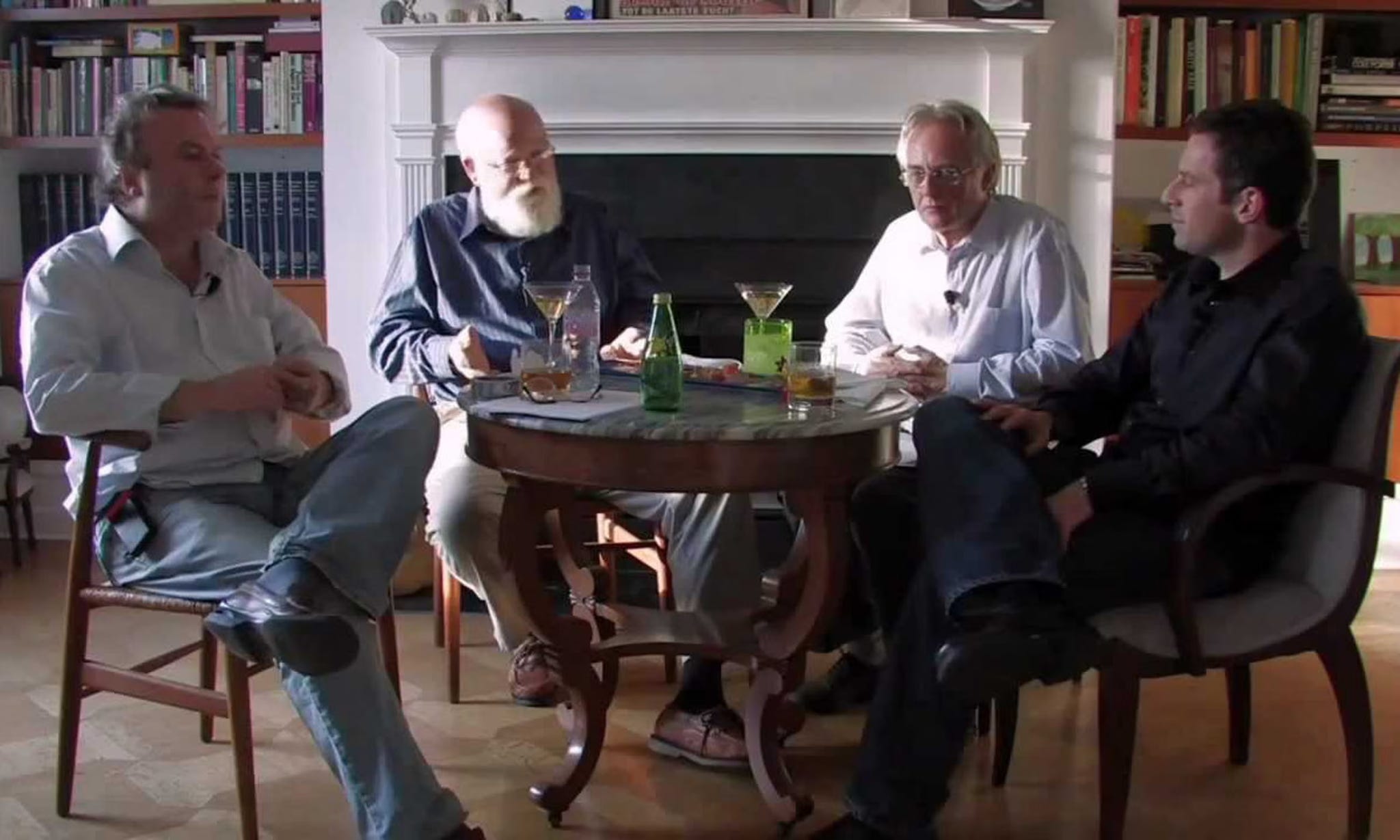
Seven months after the christening, the four horsemen finally gathered together. On September 30, 2007, at Christopher Hitchens’s home in Washington, D.C., they sat down for a two-hour unmoderated conversation, filmed for the Richard Dawkins Foundation. There was no audience, moderator, or set. There were four armchairs around a round wooden table, whiskey already poured, and walls of books on either side. Around that table sat Hitchens, sleeves rolled up and ferociously animated; Dennett, bearded and slower in cadence; Dawkins in a white shirt and glasses; Harris, clean-shaven and the youngest in the room, sitting slightly apart. At one point, Harris asked the question none of the others had quite asked: “Is there any argument for faith that has given you pause?” The room considered it briefly and moved on.
The movement now had a name, four faces, and a filmed record of its own certainty. What it did not yet have was any reason to doubt itself. And with the success it was having, why would it?
Prophecy
In June 2008, Ariane Sherine, a comedy writer and journalist, proposed an atheist bus campaign in The Guardian in response to a Christian one she had seen weeks earlier. Backed by Richard Dawkins and the British Humanist Association, the fundraising opened with a target of £5,500 and closed at more than £150,000, roughly 27 times the original amount. On January 6, 2009, 800 buses rolled out across Britain, each one carrying a line that softened the movement’s usual pitch into a joke: “There’s probably no God. Now stop worrying and enjoy your life.” At the launch, Dawkins was photographed smiling with Sherine in front of one of the buses.
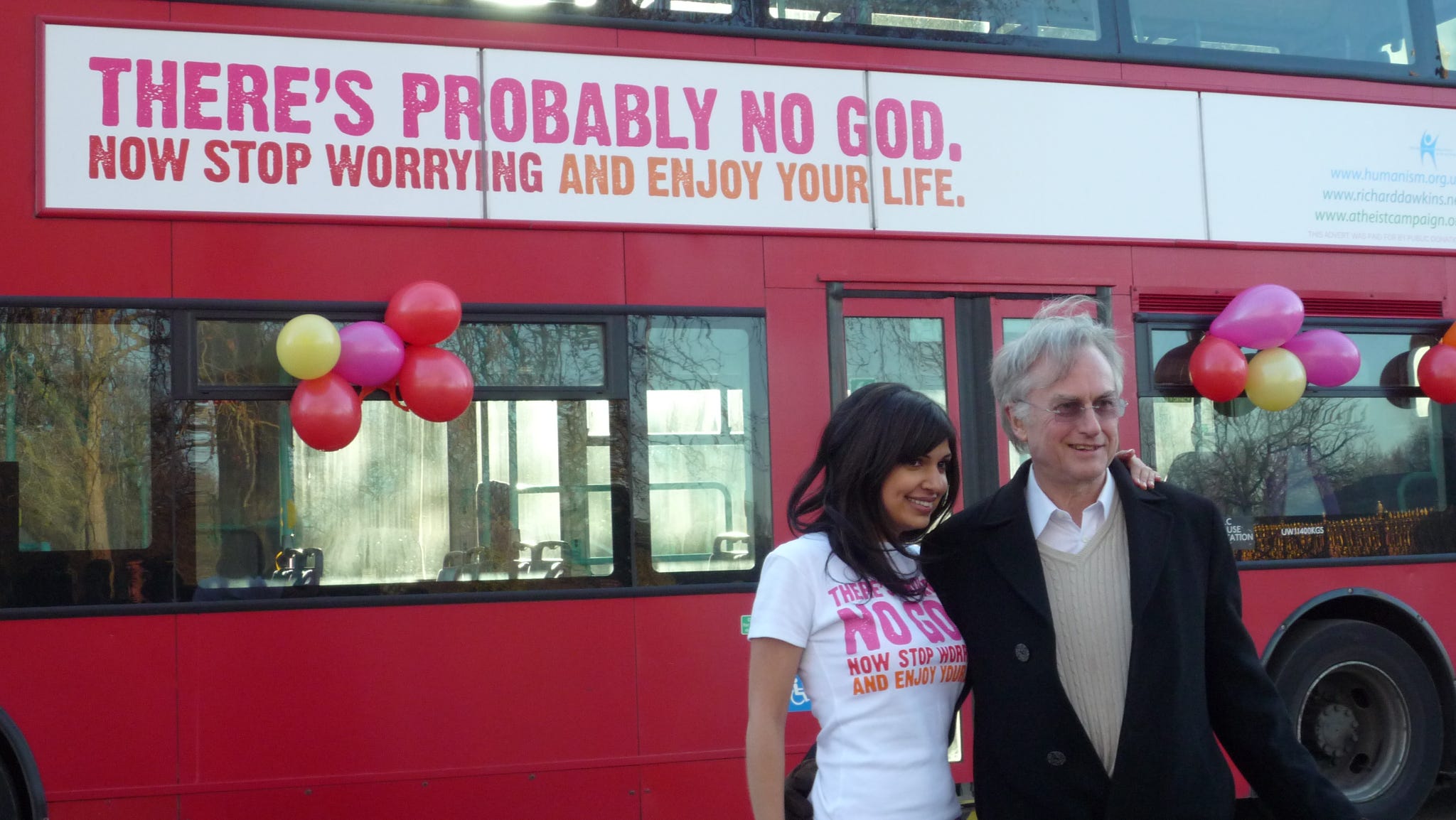
The bus campaign was also one of the first proofs of concept for what would later be called internet crowdfunding. The model that would build everything from Kickstarter to GoFundMe was being trialled by the New Atheists in those early years of the internet.
By this point, New Atheism had become a multi-million-dollar industry of its own right. The God Delusion would eventually sell more than three million copies in English. God Is Not Great had gone to number one on the New York Times list in seven weeks. Harris alone attracted between $100,000 and $200,000 per appearance, addressing audiences in academia, corporations, and debate panels, both new and old. The Edge Foundation, ground zero for the intellectual salon network, gathered scientists, technologists, and financiers at its annual Billionaires’ Dinners, held alongside the TED conference. Brockman represented Dawkins, Dennett, Pinker, Krauss, and dozens more, taking around 15% on every deal.
The industry reached its fullest expression in March 2012, on the National Mall in Washington, D.C., during the Reason Rally—branded as the largest secular gathering in American history. Dawkins, Krauss, and a roster of comedians, scientists, and musicians took the stage. The crowd, electrified and rain-soaked, roared in unison: “We’re here, we’re godless, get used to it.”
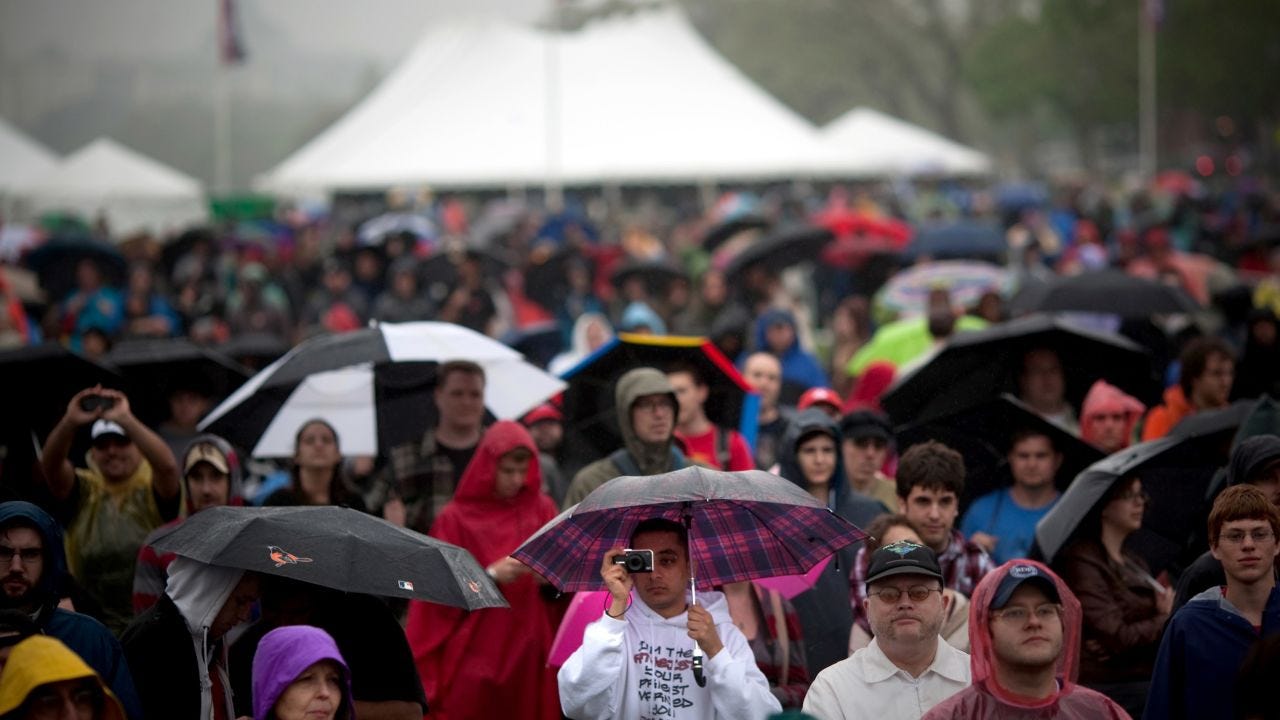
It was, although no one in the crowd would have known it, the movement’s high-water mark. Google Trends suggests that interest in New Atheism and related ideas peaked broadly in the early 2010s, while the 2012 Reason Rally marked its organisational apogee. What followed was decline.
In June 2010, Christopher Hitchens announced that he had been diagnosed with oesophageal cancer. He continued to write, debate, and speak almost until the end. In November of that year, in Toronto, he met Tony Blair on a Munk Debate stage to argue the resolution “Be it resolved, religion is a force for good in the world.” Already five months into treatment, he won the audience vote 68% to 32% against the motion—the largest margin in the series’ history. It would be his last great public set-piece. He died on December 15, 2011, at the age of 62. The most magnetic performer the New Atheists had ever produced was gone.
The Reason Rally proceeded without Hitchens. It also proceeded without Rebecca Watson, who had been quietly removed from the speaker list at Dawkins’s request. The crowd had not yet noticed, but the first fault lines that would later undermine New Atheism were beginning to show.
Fault Lines
Into the early 2010s, it seemed clear that religious adherence was slowly declining, but despite this, believers and non-believers seemed to live in an uneasy harmony, without locking horns as was once assumed. Scott Alexander captured the cultural developments of the 2010s in his Astral Codex Ten essay, New Atheism: The Godlessness That Failed. The secular-liberal Blue Tribe, as Alexander remarked, found a new set of causes against which to project their identity—the Ferguson shooting, the rise of Black Lives Matter, and the emergence of a politics centred around race and gender rather than God and disbelief. In short, the religious culture wars of the 2000s, catalysed by 9/11 and the ensuing War on Terror, had begun to peter out.
The New Atheists still had forward momentum but were increasingly estranged from the emerging political and cultural moment of the 2010s. That became an increasing drift toward a series of positions antithetical to the Blue Tribe. Perhaps knowingly or unknowingly, the New Atheists may have sensed their coming divorce, and Dawkins’s statements thereafter were anything but white noise.
In September 2013, in an interview with The Times magazine, Dawkins described the sexual abuse he had experienced at his English boarding school as “mild paedophilia” and said he did not believe it had done him lasting harm. He framed it as a question of historical context—one could not judge the past by present standards. His audience heard something else entirely.
Dawkins’ statement could have been mistaken as a one-off faux pas, but the gaffes continued. In July 2014, he tweeted that date rape was bad but stranger rape at knifepoint was worse, and told those who disagreed to “go away and learn how to think.” In August 2014, responding to a follower who said she would feel “morally obliged” to continue a pregnancy after a Down syndrome diagnosis, Dawkins replied: “Abort it and try again. It would be immoral to bring it into the world if you have the choice.”
In February 2020, he went further still, tweeting that eugenics, applied to humans, “would work” in the same way it worked for dogs and horses. “It’s one thing to deplore eugenics on ideological, political, moral grounds,” he wrote. “It’s quite another to conclude that it wouldn’t work in practice. Of course it would.”
With his statements, Dawkins had been flag-posting all along the decade-long process of divorce between New Atheism and the Blue Tribe, who increasingly viewed the movement as a déclassé cause associated with ‘the other side’: Trumpists, misogynists, sexists, racists, and other assorted thought criminals.
The most visceral critiques came from within. The biologist PZ Myers, whose blog Pharyngula had been one of the rockets of New Atheism’s parabolic flight, wrote in 2019 that the movement had become “a shambles of alt-right memes and dishonest hucksters mangling science to promote racism, sexism, and bloody regressive politics.” Its most influential voices, he said, had “aimed the ship of atheism straight into the Trumpkin swamp.”
The Elevatorgate scandal in the summer of 2011 heralded the beginning of something the internet had not yet seen at that scale: an identity-based pile-on, conducted across forums, YouTube, and the comment sections of formerly collegial blogs, with a woman at its centre. Academic researchers were already studying it as a new phenomenon: at least one peer-reviewed paper would later treat Elevatorgate as a case study in the rhetorical construction of morality online. Three years later, in August 2014, Gamergate would follow the same script: a woman, a male-dominated community, an identity-based fracture amplified by the same platforms, and the same outcome.
New Atheism had rested easy in its offensive posture of raining down critiques of reason against religion. Increasingly, others began to direct their own barrage of criticism at the New Atheists, whose inability to withstand the same critiques they had levelled at others revealed something they had never quite admitted: that “reason” had always meant something more specific than they claimed. Reason, it turned out, was far more complicated than God versus no God. It was also about who got to wield it, and in which direction.
The sociologist Steve Kettell saw that the movement had built itself on what he called an “empty signifier”—a label capacious enough to mean almost anything, which was precisely its early strength. Under the banner of atheism, libertarian conservatives, progressive feminists, secularist campaigners, and anti-Islam hawks could all gather, because the banner said nothing about what they actually believed beyond a single negation. When the movement expanded and had to take positions on questions other than God’s existence: on feminism, on social justice, on Islam, on identity, the emptiness that had held it together became the thing that tore it apart. There was no shared foundation from which to adjudicate.
Within the broader secular world itself, a quieter verdict was taking shape. The philosopher Michael Ruse, himself an atheist and one of the most experienced opponents of creationism in the American academy, published a piece in 2009 that became widely quoted, where he called the New Atheists a “bloody disaster.” His case was that they were philosophically unsophisticated, strategically counterproductive, and were doing real damage to the cause of science education by alienating the religious moderates who were its natural allies. They had, he argued, mistaken loudness for rigour.
Reza Aslan, writing the same year, argued that the New Atheists displayed an utter lack of literacy in the subject they were so desperate to refute, “shallow scholarship mixed with evangelical fervour.” Terry Eagleton, reviewing The God Delusion in the London Review of Books, reached for a simpler image: reading Dawkins on theology, he wrote, was like reading someone who had learned all their biology from the Book of British Birds. Alvin Plantinga, the philosopher of religion, was blunter still: many of Dawkins’s arguments, he said, would receive a failing grade in a sophomore philosophy class.
Perhaps the most unsettling critique came from within the atheist tradition itself. Thomas Nagel—NYU philosopher, lifelong atheist, and author of the landmark 1974 essay “What is it Like to be a Bat?”—reviewed The God Delusion in The New Republic in 2006, the year it was published, and called it “a very uneven collection of scriptural ridicule, amateur philosophy, historical and contemporary horror stories, anthropological speculations, and cosmological scientific argument.” Unlike Dawkins’s books on evolutionary theory, Nagel wrote, it lacked “superb instructive lucidity”; his attempts at philosophy appeared to have been included “for the sake of completeness.” More specifically, Nagel identified a category error at the heart of Dawkins’s central argument: Dawkins rebutted the design argument by treating God as though he were a complex physical inhabitant of the natural world, subject to the same demands for explanation as everything else. But this, Nagel observed, was not what any serious theologian meant by God. The point of the God hypothesis was precisely that not all explanations are physical, that there might be intentional or purposive explanations more fundamental than the laws of physics. Dawkins had demolished a God that his opponents did not believe in.
Six years later, in Mind and Cosmos (2012), Nagel went further still, arguing that the materialist neo-Darwinian framework underpinning the New Atheist worldview was almost certainly false—not wrong about God, but wrong about mind. When his arguments were raised at a workshop attended by Dawkins and Dennett, the response was not engagement but contempt. Dennett sighed. Others called Nagel an idiot. The movement that had built its identity on the courage to follow reason wherever it led had encountered a serious philosophical argument from a serious philosophical atheist, and looked away.
In the same year as Ruse’s verdict, the Pulitzer Prize-winning journalist Chris Hedges, a former New York Times Middle East Bureau Chief who had covered the wars in Bosnia and Kosovo and held a Master of Divinity from Harvard, published I Don’t Believe in Atheists (2008). Hedges was writing from the left and from the field, from 15 years of watching what religious violence actually looked like up close. The New Atheists had created, he argued, a new form of fundamentalism that promoted a simplified worldview of us versus them, a belief in human moral progress through science and reason that was, in his reading, as utopian and as dangerous as any theology it claimed to replace.
The political impact of the movement was fully cross-examined in 2019, in a study led by Nick Megoran of Newcastle University and Russell Foster of King’s College London. A diverse panel—Christian, agnostic, and atheist—examined the New Atheists’ positions on US and UK foreign policy since 9/11. They found that the three principal horsemen (with the exception of Dennett) had backed the attack on Afghanistan in 2001. Harris, in The End of Faith, had framed Western engagement with the Muslim world as a war the West must win or face “bondage,” had suggested racial profiling and coercive interrogation might be ethically defensible, and had argued that a nuclear first strike against an Islamist nuclear state might be “the only course of action available.” Hitchens had been among the most vocal advocates for the Iraq invasion in 2003, and described the 9/11 attacks as producing in him “exhilaration.” Here, at last, was the opportunity to rally the free West against theocratic and authoritarian regimes.
The researchers concluded that the New Atheists had built a world with “us versus them” at the centre of the debate. They imagined civilisations bearing different flags and reiterated the clash-of-civilisations thesis. Dogmatically, they refused complexity and nuance, almost leaving the hat of reason behind at the table. A movement that had deplored the violence religion flamed had, in its own words, defended some of the most brutal conflicts of its time.
Then came the evening of October 3, 2014, and a television studio in Los Angeles. Sam Harris appeared on Real Time with Bill Maher alongside Maher himself. The conversation turned to Islam. Maher called it the “mother lode of bad ideas.” Harris elaborated.
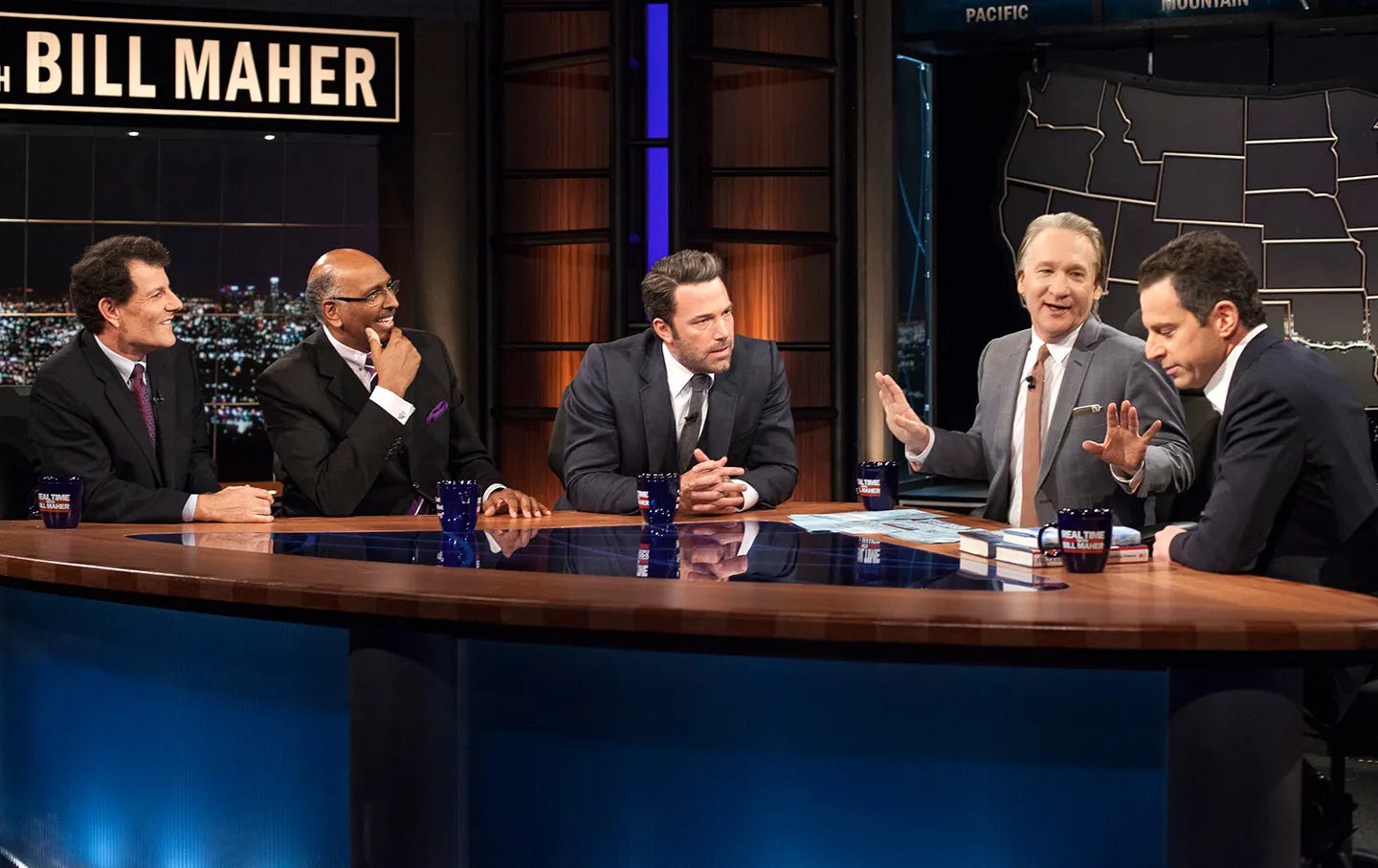
Ben Affleck, seated at the same table, interrupted: “It’s gross. It’s racist.” Nicholas Kristof agreed. The clip went viral within hours and continued to circulate for weeks. To Harris’s supporters, it was the defining moment of liberal cowardice, the Blue Tribe, and the broader secular left, refusing to apply its own principles consistently. To his critics, it was something else: the moment New Atheism’s critique of Islam, which had been building since The End of Faith in 2004, finally revealed what it had always risked becoming. The charge of Islamophobia had been circulating in left-wing commentary since at least 2012. Glenn Greenwald had made the argument repeatedly, and the Southern Poverty Law Center had documented how New Atheist rhetoric was being recycled in explicitly anti-immigrant contexts.
What Affleck did on that stage was voice what a significant section of the Blue Tribe audience had already concluded. By the time he said the word “racist,” many of them had already made their divorce from New Atheism. They learned what they could from this early internet-driven movement and its success, and applied those lessons in new, more viral ways. The religious fault line that fuelled the culture wars of the 2000s would give way to the 2010s, and its “intersectional” emphasis on race, gender, and sexuality against misogyny, racism, and fascism, led by the Blue Tribe. The eventual backlash against it took the form of the election of Donald J. Trump in 2016 (and again in 2024).
By 2016, the movement’s organisational infrastructure was visibly collapsing. Conference attendance had peaked around the Reason Rally in 2012 and declined sharply afterwards. Campus atheist groups struggled to maintain membership. The institutions the New Atheists had built, with their foundations, festivals, and annual conventions, were either contracting or fragmenting along new fault lines. Quietly, many of the movement’s reigning figures began to move on to new things.
Renegade
William Stahl argued that New Atheists and religious fundamentalists were mirror images of each other, sharing deep epistemological parallels beneath their apparent opposition. Both claimed a monopoly on truth; both treated complexity as a moral failure; both responded to a crisis of authority with backlash rather than reflection; and both, when pressed, abandoned their own stated epistemic standards. The New Atheists claimed the authority of science while arguing unscientifically; the fundamentalists claimed the authority of scripture while interpreting it selectively. “In the end,” Stahl concluded, “fundamentalism and the New Atheism are mirror images of each other, sharing deep structural and epistemological parallels.” The New Atheists would have furiously disputed the comparison. The decade ahead would not help their case.
Core to the New Atheist movement was another charismatic figure. Ayaan Hirsi Ali was born in Mogadishu in 1969, the daughter of a political dissident imprisoned by the Siad Barre regime. Her childhood was spent in exile, in Saudi Arabia, then Ethiopia, and then Kenya. In 1992, she made her way to the Netherlands and applied for asylum. She later acknowledged lying on that application about her name, her age, and her route, having come via Kenya and Germany rather than directly from Somalia. She had acknowledged the falsification as early as 2002, during candidate vetting for parliament, and there were no objections at the time. It was only when a Dutch television documentary re-aired the matter in 2006—including interviews with family members who disputed the forced marriage account that had underpinned her asylum claim—that the immigration minister ruled her naturalisation was improperly granted. She resigned her parliamentary seat and left the Netherlands within weeks, bound for the American Enterprise Institute in Washington. She later served as a research fellow at Stanford’s Hoover Institution and became a US citizen in 2013.
Hirsi Ali’s arc toward atheism had begun with Bertrand Russell’s 1927 lecture “Why I Am Not a Christian”, a text she encountered in the aftermath of 9/11. Its scepticism towards religion in general gave Hirsi Ali the framework she needed. After formally renouncing Islam, she found herself in agreement with Russell, Hitchens, and Dawkins on organised religion and was drawn into the movement’s orbit. Alongside the four horsemen, she is sometimes referred to as the fifth—the horsewoman. Tall and composed at the podium, and touted by Dawkins and Hitchens as “fun and clever,” she became a key figure in the movement, carrying an authority that was not merely rhetorical: a black African woman and of ‘Muslim heritage’, she brought to the movement something its white male principals could not supply: internal legitimacy for their external critiques against religion and Islam.
That authority was nowhere more visible than on the evening of October 6, 2010, in the Skirball Center for the Performing Arts at New York University, where Intelligence Squared hosted a debate on the motion “Islam is a Religion of Peace.” Hirsi Ali, alongside the writer Douglas Murray, argued against. Maajid Nawaz—a former Islamist and member of Hizb Al-Tahrir, who later became the founder of the counter-extremism Quilliam Foundation—argued for. Before the debate, 41% of the audience supported the motion, 25% opposed it, and 34% were undecided. After it, 55% opposed the motion, and only 36% still supported it.
Hirsi Ali, however, had recognised where the movement’s trajectory was heading: it was no longer propelled by the threat of violent Islam, or at least not with the same force. That vacuum created a dilemma for her about the beliefs and moral canopy she had constructed. What grounds the values, norms, and philosophical hue of Western civilisation? Like Dawkins, Hirsi had a tribe, and one that her politics was not shy of hiding. Her answer to this question would be sealed by her own sense of longing and transcendental bankruptcy.
In November 2023, she published an essay in UnHerd titled “Why I Am Now a Christian“—reversing Russell’s title. Western civilisation, she argued, faced three converging threats: the expansionism of authoritarian regimes in China and Russia; the rise of global Islamism; and what she called “the viral spread of woke ideology, which is eating into the moral fibre of the next generation.” Against such forces, secular tools, such as arguments, technologies, and military force, were inadequate. Upholding Judeo-Christian traditions was, in her view, the most credible answer for Western society’s survival. But the decision was also personal. She had found life without spiritual solace, she wrote, “unendurable—indeed, very nearly self-destructive.”
The essay generated two competing readings that together capture the conversion’s ambiguity. Sarah Jones, writing in New York magazine, argued that for Hirsi Ali, “atheism only ever propped up her career as a culture warrior”, that she was abandoning a movement “in terminal decline” for a new vehicle, and “remains on the same crusade, inveighing against Islam and having simply exchanged one banner for another.” Ross Douthat, in The New York Times, offered a more generous interpretation: that the conversion reflected a twofold realisation—that atheistic materialism was too weak a foundation for Western liberalism, and that she had found the long-term experience of life without spiritual solace genuinely unendurable.
In a subsequent discussion with Dawkins, Hirsi Ali stated that she believed in the resurrection, and Dawkins acknowledged that she was not merely a political Christian. The man who had once welcomed her into the New Atheist movement was now being asked to take her new faith seriously.
Where Hirsi Ali secured a relatively safe ejection out of the crumbling edifice of New Atheism, many of her once-fellow travellers were not so lucky. Only recently was the wider network that had been quietly financing the intellectual infrastructure of the New Atheist movement for more than a decade revealed. For all their relentless questioning, the New Atheists seemed reluctant to ask who funded the rooms in which the ideas circulated and what those funders expected in return. They would come to regret it.
The Epstein Connection
In the first decade of the 21st century, three key institutional pillars of the West faced increasing distrust and scandal. However, it would be the Epstein files that, perhaps decades from now, would be seen as the fundamental turning point that consolidated the downward trajectory in public trust in institutions. They laid bare the networks of power, wealth, and influence, and how they were laundered through reason and science, perverting the epistemic authority of science that underwrites all contemporary institutions. The Epstein files also form a crucial part of the post-mortem New Atheism and its meteoric rise and fall.
The more than 20,000 pages of Epstein-related documents released by the U.S. House Oversight Committee on November 12, 2025, placed three of the four Horsemen—Dawkins, Dennett, and Harris—alongside Krauss and Pinker in the same financial and social orbit as the convicted sex offender, Jeffrey Epstein.
Whilst these connections do not imply personal wrongdoing, they showed that the New Atheist movement had failed to provide an honest account of how it rose to such popularity and fame. How did a movement running on mantras of “evidence” and “critical thinking” either defend, accommodate or ignore a figure like Brockman? Whether the ‘New Atheists’ turned a blind eye or were simply overtaken by the fame, their failure to reflect on their surroundings has proven consequential.
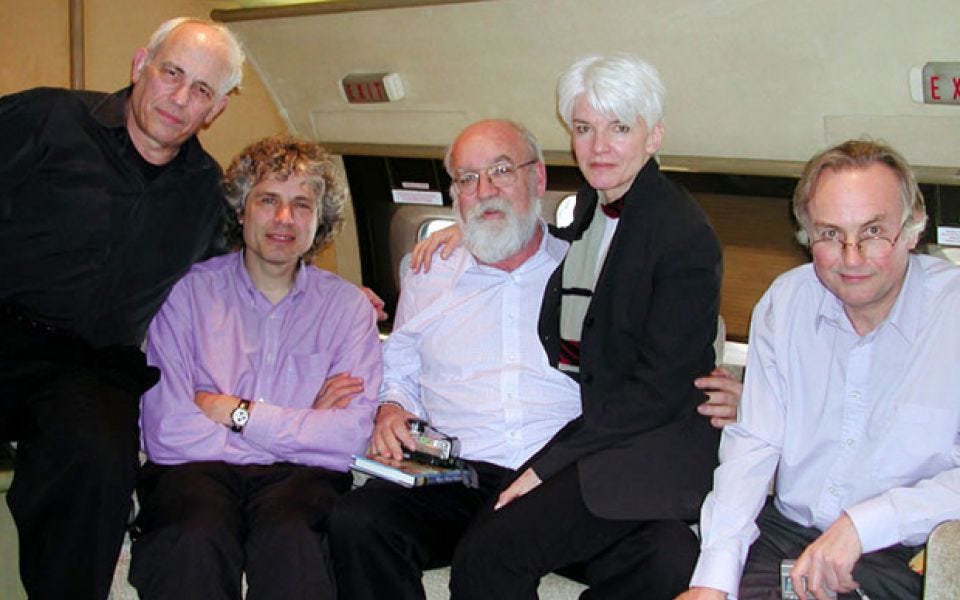
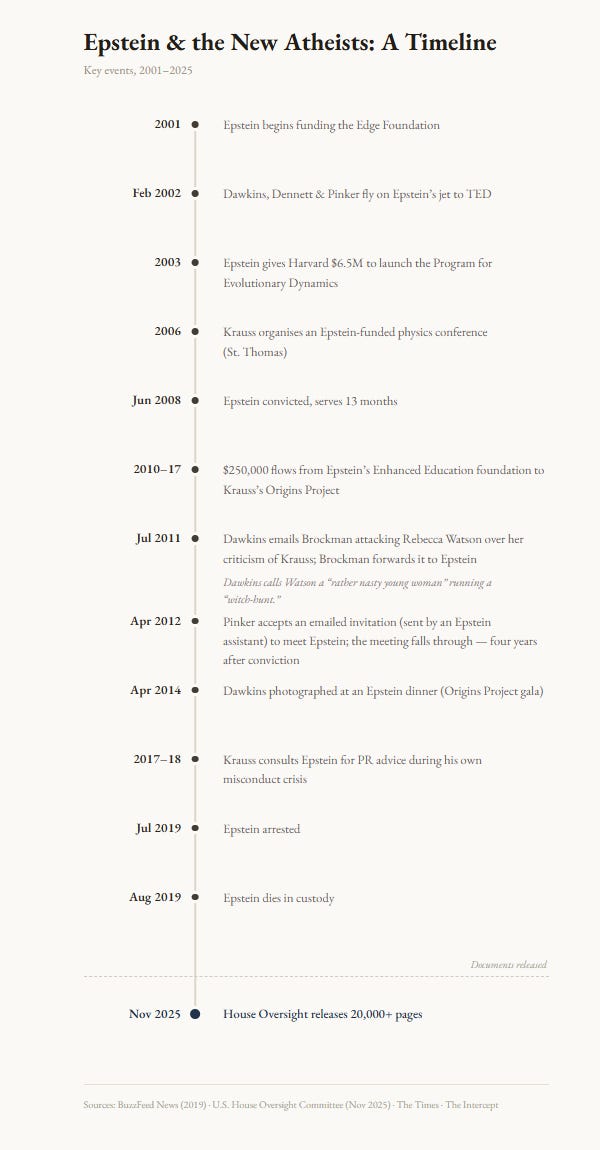
The Epstein connection to scientific publishing and the New Atheist movement primarily operated through one man: Brockman. He had represented Dawkins, Dennett, and Pinker as their literary agent since the 1980s, and his Edge Foundation—the annual salon that hosted the movement’s intellectual circuit—had received $638,000 from Epstein between 2001 and 2015, making him the foundation’s largest funder, and in some years its only donor. Of approximately $857,000 in total donations Edge received in that period, roughly 74% came from Epstein-linked entities. In February 2002, Brockman, his wife Katinka Matson, Pinker, Dawkins, and Dennett had flown to the TED conference in Monterey on Epstein’s private jet. The caption to the photograph documenting that flight was later altered to remove mention of Epstein. His Edge profile, which had described him as a “financier and science philanthropist,” was removed entirely. Two other 2002 dinner photographs vanished from the foundation’s website. So did a photograph of Sarah Kellen—named as a “possible co-conspirator” in Epstein’s 2008 non-prosecution agreement—who was pictured at that year’s Billionaires’ Dinner alongside Brockman.
Lawrence Krauss had been the movement’s most visible scientific evangelist outside the four Horsemen—a frequent Reason Rally speaker, Dawkins’s co-star in the 2013 documentary The Unbelievers, and the founder and director of the Origins Project at Arizona State University, where his 2017 salary was reported as $265,000. In February 2018, BuzzFeed News published a report documenting six allegations of sexual misconduct against him spanning more than a decade. ASU placed him on administrative leave that March, removed him from the Origins Project in August, and accepted his resignation in May 2019.
When the Epstein files were released in November 2025, what they revealed about Krauss was something beyond the misconduct story his critics already knew. Emails showed that during the 2018 BuzzFeed crisis, Krauss had turned to a convicted sex offender for advice on how to respond to allegations of sexual misconduct against himself, sending Epstein possible cross-examination questions for his accusers, forwarding articles on the dos and don’ts of apology, and accepting Epstein’s edits on draft statements. Epstein in turn forwarded the inquiry to Ken Starr, the former Baylor president who had himself resigned amid the Baylor sexual-assault scandal, for additional advice. The relationship had begun years earlier. In 2006, Krauss had organised a scientific conference on the Caribbean island of St Thomas near Epstein’s private island, funded by the J. Epstein VI Inc. Foundation. Between 2010 and 2017, Epstein’s Enhanced Foundation had donated $250,000 to the Origins Project. In a 2011 interview with The Daily Beast, Krauss had publicly defended Epstein after his 2008 conviction, saying the women around him were “ages 19 to 23” and that, “as a scientist, I always judge things on empirical evidence”—meaning he would believe Epstein over his accusers.
In contrast to Krauss, a spotlight-loving public figure, Steven Pinker was a stalwart of the academic establishment. An illustrious cognitive scientist by profession, he argued in his books The Better Angels of Our Nature (2011) and Enlightenment Now (2018) for moral whiggery and societal progress. Both became commercial successes, championed by Bill Gates and circulated through the Edge salon network during years when that network was being substantially funded by Epstein. Pinker describes his relationship with Epstein as one of mutual dislike, but the record does not merit this. They were far more entangled than the framing lets on. He had flown to the TED conference on Epstein’s jet in February 2002, alongside Brockman, Dawkins, and Dennett. In July 2007, his Harvard colleague Alan Dershowitz used a linguistic analysis that Pinker had provided to argue that the federal internet-luring statute did not apply to Epstein, a footnote in the legal filings that helped secure Epstein’s controversial non-prosecution agreement. Pinker has said he did not know the question pertained to Epstein and now regrets writing the letter.
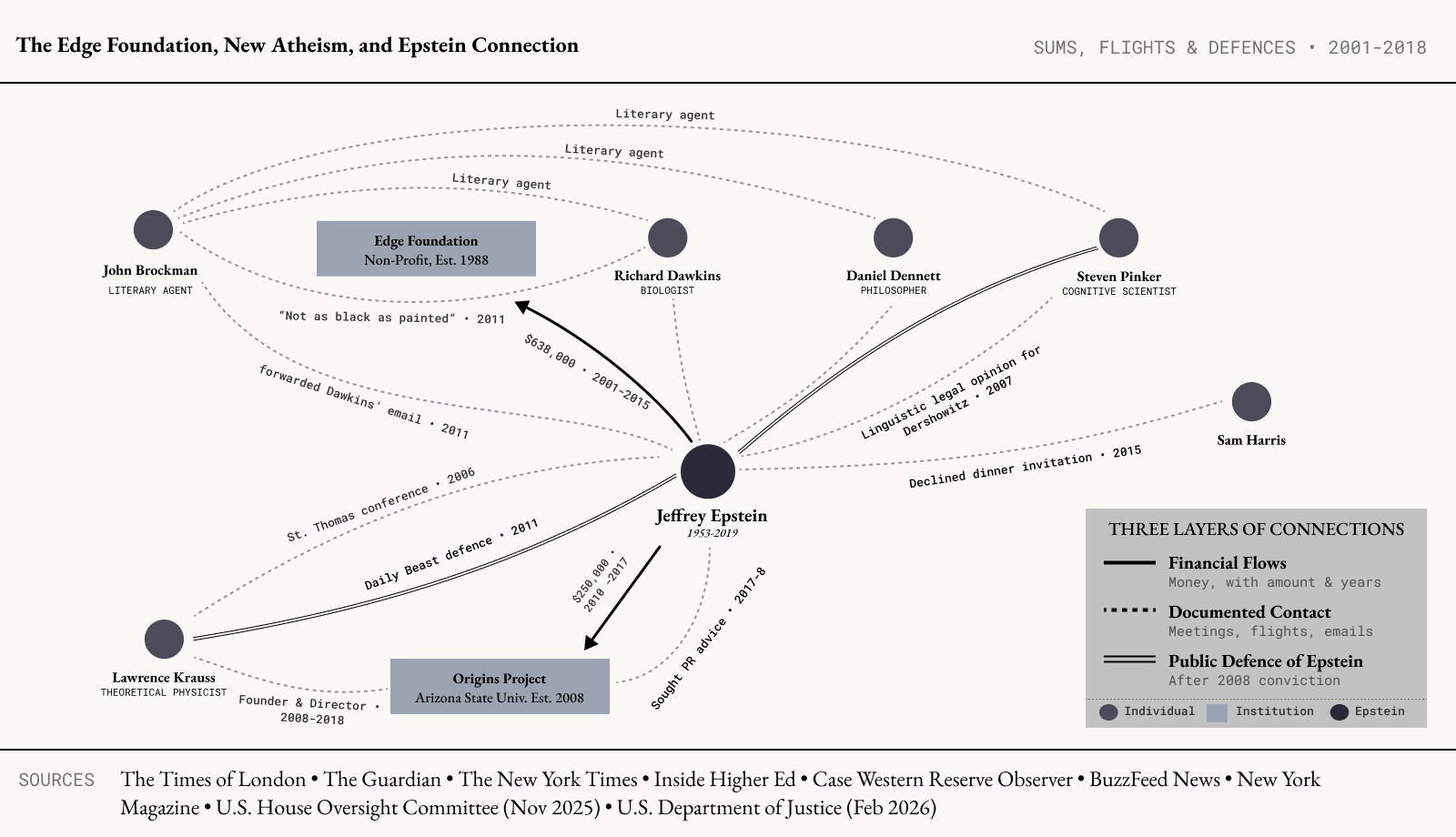
What the November 2025 release made harder to dismiss was the timing of the subsequent contact. In an email dated April 12, 2012—four years after Epstein’s guilty plea—Brockman wrote to Pinker: “Jeffrey Epstein will be making a trip up to Harvard on Sunday, April 15th. He is wondering if you might be around and available to meet with him?” Pinker replied that he would be out of town on the Sunday, but added: “If Jeffrey is around on Monday the 16th, I’ll be back and would be delighted to meet with him.” In 2020, more than 600 linguists signed an open letter to the Linguistic Society of America asking that Pinker’s Fellow status and his place on the Society’s Media Experts list be revoked, citing his linguistic testimony in favour of Epstein among other grievances. The Society declined to act. Pinker remains the Johnstone Family Professor of Psychology at Harvard.
The emails released in 2025 showed that Epstein continued to attend Edge dinners after his 2008 conviction, with Brockman’s invitation at least into 2015. At the March 2011 dinner in Long Beach, California, Epstein was photographed alongside Jeff Bezos, Sergey Brin, Anne Wojcicki, Elon Musk, Marissa Mayer, and Nathan Myhrvold. In July 2011, after Watson’s elevator video and her criticism of Krauss’s defence of Epstein had begun circulating, Dawkins emailed Brockman: “There is a rather nasty young woman who seems to be running some kind of a witch-hunt against Lawrence Krauss because of his defence of Jeffrey Epstein. I remember that you told me something of the circumstances of Jeffrey’s arrest, and that his case is not as black as painted. Might you possibly remind me of it.”
Brockman forwarded the email to Epstein himself, attaching the note: “FYI, see Richard Dawkins email below alerting me to a campaign against our friend LMK re: his friendship with you. I’ll deal with Richard.”
Three years later, in April 2014, Dawkins was photographed seated at the same Arizona dinner table as Epstein, at an Origins event partly funded by Epstein’s foundation. Dawkins has said he does not recall the dinner.
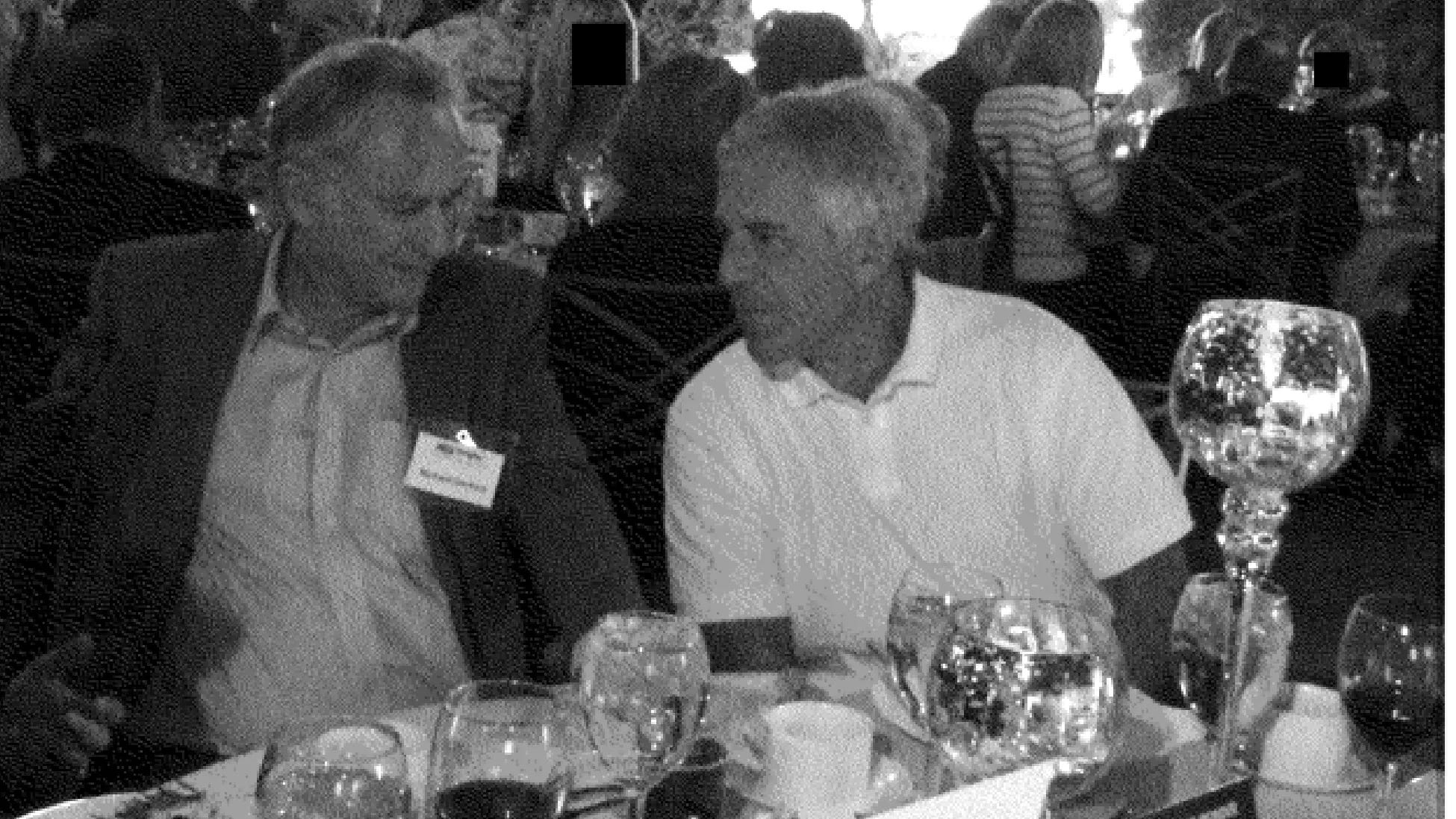
Sam Harris, whose name appears in the files in connection with a declined dinner invitation, addressed the matter on his podcast in February 2026: he had met Epstein once at a TED lunch, found him off-putting, and declined the subsequent invitation to dine with him and Woody Allen.
PZ Myers, writing on Pharyngula in February 2026 after his own marginal appearance in the files, captured the social mechanics more cleanly than any of the principals. “Brockman was the king of scientific publishing,” he wrote. “If you wanted to publish a science book, you had to make the pilgrimage to New York and kiss the feet of John Brockman, who would then negotiate with the publishers to get you a good deal.” The agency, the salon, the foundation, the financier, all running on a single network with a single gatekeeper, who in turn was working with money that everyone preferred not to examine. “It was just an incestuous little clique,” Myers wrote.
The institutional reckoning that followed was radically uneven. Lawrence Summers, the former Treasury Secretary and Harvard president, whose correspondence with Epstein continued until weeks before the financier’s 2019 death, resigned from the OpenAI board within seven days of the November 2025 release. He stepped back from teaching at Harvard and lost his contracts with the New York Times, Bloomberg, and the Center for American Progress. In March 2026, he announced his full resignation from his Harvard University Professorship. Martin Nowak, who had run Harvard’s Program for Evolutionary Dynamics—launched in 2003 with a $6.5 million Epstein gift, the single largest the financier ever made to a Harvard program—was placed on paid administrative leave that same month. Both men had been the most directly compromised by documented financial transactions.
The same reckoning has not yet reached the New Atheists. Pinker remains in his Harvard chair. Dawkins remains Oxford emeritus. Hirsi Ali remains at the Hoover Institution. Brockman Inc., the literary agency at the centre of the apparatus, continues to operate. Taken together, the files revealed no conspiracy. It was something quieter and more unsettling: a network of men who had built a movement on the authority of reason, and who had moved through the orbit of a convicted sex offender without, in any documented case, asking the question that reason would have demanded.
Losing Faith in Atheism
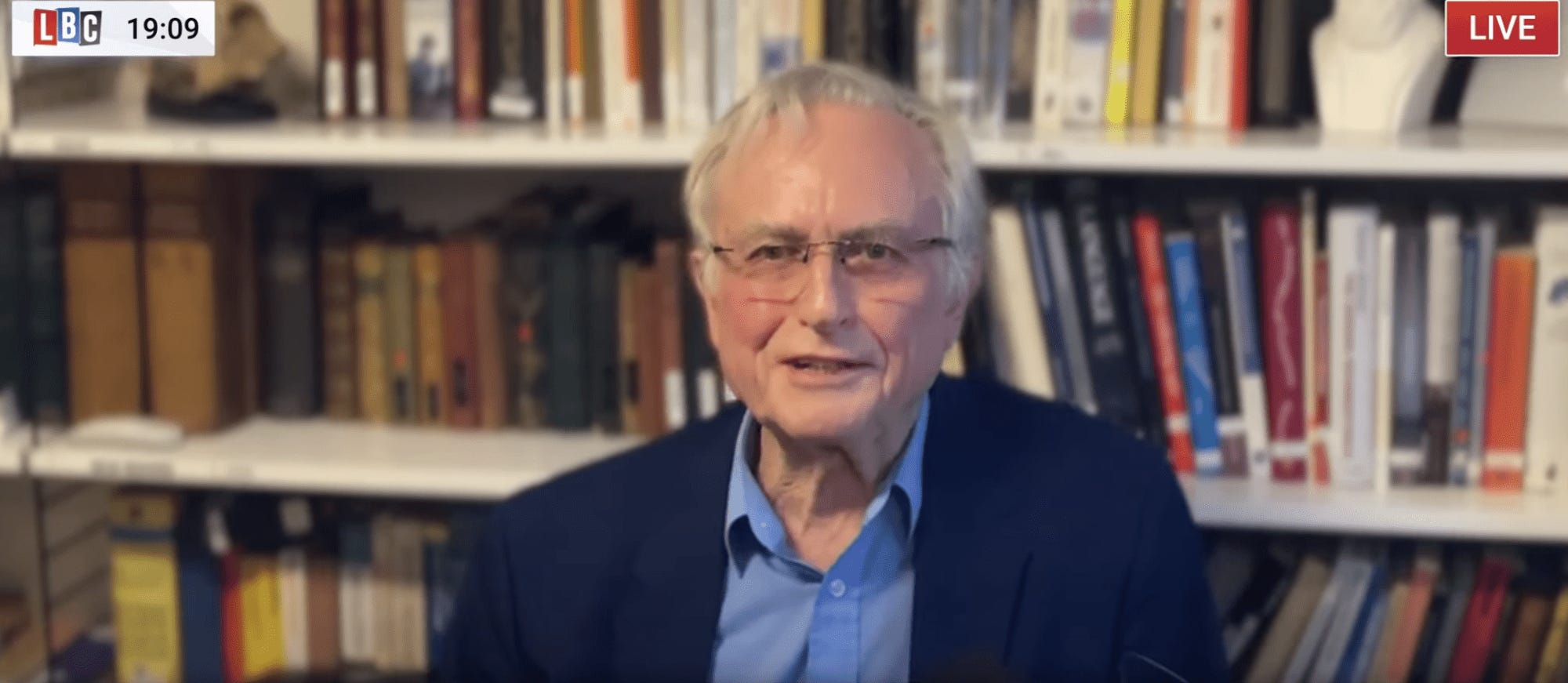
Richard Dawkins had been arriving at a not entirely different position from Hirsi Ali, though by a very different route. In January 2024, writing in The Spectator about Hirsi Ali’s conversion, he noted that “Christianity is our best bulwark against Islam” and concluded that if supporting Christianity over Islam was all it took to be called a Christian, he was a Christian too. On Easter Sunday, March 31, 2024, he made explicit his newfound appreciation for Christianity in an interview with Rachel Johnson on LBC radio. Perhaps in light of the Mayor of London, Sadiq Khan, having turned on 30,000 Ramadan lights on Oxford Street on the cusp of Easter weekend. Dawkins said he was “slightly horrified,” and called himself a “cultural Christian.” He did not believe “a single word of the Christian faith,” he said, but he loved hymns and Christmas carols, felt at home in the Christian ethos, and would choose Christianity over Islam “every single time.” It was, in his terms, “a fundamentally decent religion, in a way that I think Islam is not.”
What is extraordinary about this position is that it is not a positive argument for religion, but a definition by exclusion. Dawkins made no case for Christianity’s values on their own terms, invoking the Ramadan lights, the King’s sympathies, and the need for a civilisational bulwark, but when pressed to explain why Christianity offers superior moral ideals to Islam, he could not or did not do so. The argument was entirely negative: Christianity is better because it is not Islam. One is left to wonder whether Dawkins had forgotten the God he had described in The God Delusion as “a vindictive, bloodthirsty ethnic cleanser; a misogynistic, homophobic, racist, infanticidal, genocidal, filicidal, pestilential, megalomaniacal, sadomasochistic, capriciously malevolent bully”—and yet was now prepared to accept that same God’s civilisational legacy as a fleeting gift worth defending.
Critics noted he had been making versions of this argument since at least 2007. What was new was the context—a post-October 7 2023 Europe in which the question of which religion was acceptable in public life had acquired an urgency the New Atheists had not anticipated when they first imagined religion’s retreat. In April 2021, the American Humanist Association withdrew the Humanist of the Year award it had given him in 1996. The proximate cause was a tweet comparing Rachel Dolezal’s claim to a Black identity with the assertion that transgender people literally belong to the sex or gender with which they identify. The AHA cited his “repeated failing to acknowledge his own privileges and his pattern of insensitivity.” Dawkins protested. The organisation that had once celebrated him as the public face of secular humanism had formally severed its relationship with him. In July 2025, he contributed a chapter to Lawrence Krauss’s edited anthology The War on Science, alongside Jordan Peterson, Niall Ferguson, and Jerry Coyne, arguing that scientific truth stood above human feelings and politics. The greatest threat to science was ‘woke culture’, which threatened facts and logic. Yet, the book came out during a government-led assault on science funding, when most of its contributors, Dawkins included, had spent the preceding decade arguing primarily against progressive threats to science. Their voices were not as loud on the Trump administration’s budget cuts to the National Institute of Health.
Of the four horsemen, Sam Harris had travelled the furthest from his starting point and argued most strenuously that he had not moved at all. His podcast Making Sense, launched in 2013, was by the mid-2020s one of the most commercially successful in the English-speaking world, its preoccupations shifting from religion to free speech, from neuroscience to artificial intelligence, and from the secular left to an uneasy position outside all available coalitions. His meditation app, Waking Up, was producing an estimated $700,000 in monthly U.S. iOS revenue alone. In April 2017, he hosted the political scientist Charles Murray for a conversation on race and IQ that his critics regarded as a rehabilitation of ideas the academy had largely discredited. In April 2018, he had sparred at length with Ezra Klein over the same territory, each man convinced the other was arguing in bad faith. In August 2022, on a podcast, he said that Hunter Biden could have had “the corpses of children in his basement”, and he still would not have wanted the laptop story covered before the 2020 election, given the threat Trump posed. The clip circulated widely. To his supporters, it was evidence that the left had abandoned reason for tribe. To his critics, it was evidence that Harris had. By 2024, his podcast was largely preoccupied with artificial intelligence and existential risk.
Daniel Dennett died on April 19, 2024, at the age of 82, of interstitial lung disease, at a hospital in Portland, Maine. His final decade had been spent writing about the evolution of consciousness, the cultural transmission of ideas, and the dangers of large language models—which he had identified, before most public commentators, as “counterfeit people,” the most pressing AI risk being not human extinction but the erosion of social trust. His 2023 memoir, I’ve Been Thinking, was reviewed warmly across the philosophical press, including by old adversaries. Of the four horsemen, Dennett was the only one who had lived as a continuous intellectual project rather than as a brand. His last public interview was with Jordan Peterson, a fact that surprised his admirers, though Dennett himself seemed untroubled by the company. He had never much minded arguing with people he disagreed with. It was, he had always said, the only way to find out if you were right.
Of the books the four horsemen produced, the one that has most fully survived the movement is the one its author did not live to see published. Mortality, the collection of Christopher Hitchens’s Vanity Fair columns written between his diagnosis in June 2010 and his death in December 2011, is now widely regarded even by critics of the movement as a serious work—a meditation on dying without religious consolation, stripped of the polemical strut of God Is Not Great. It is the only New Atheist book that reads, today, as literature.
Throughout the years of internal fracture, public embarrassment, and quiet institutional decline, the underlying trend the New Atheists had identified continued undisturbed. The percentage of Americans identifying as religiously unaffiliated continued to rise—from roughly 16% in 2007, when the movement was at its peak, to over 30% by the mid-2020s. In Western Europe, religious observance continued its long retreat at an even greater rate than in the United States. In the Arab world, surveys documented a significant and largely unpublicised rise in non-belief, driven by literacy, internet access, and revulsion at groups like ISIS. The New Atheists had not caused any of this; these changes were driven by the same internet-accelerated macro trends that had buffeted the New Atheist movement and later blown it off course. But they had not been wrong about the direction of travel either.
Simulacra
Writing in 2025, Kettell concluded that the New Atheist movement as an organised political force was fractured beyond repair—pulled apart by the same culture wars it had once claimed to transcend.
Today, when people recall the New Atheists at all, they do so with bafflement and the mild puzzlement reserved for things that were once urgent and are now simply past, without fanfare. “What happened to the New Atheists?” is asked with curiosity, something now culturally irrelevant but interesting enough to remember because of its noise, the way one remembers a band that had a few hits in the early 2000s.
There will no doubt be countless more discussions of why the movement collapsed, and the reasons will be diverse. But the story has been told mostly the wrong way. New Atheism was not, in the end, a story about the battle between God and Reason. It was the first permutation of forces in the new world to emerge in the first decade of the 21st century, and it has since reshaped everything. The institutional vacuum that had created the movement—the discredited Church of 2002, the discredited State of 2003, the discredited Market of 2008—also denied it any positive ground on which to stand. The internet that had built the movement turned out to be the same internet that destroyed it: the medium that scaled the coalition also scaled the fault lines within it. The reason-versus-faith axis that the movement had organised itself around turned out to be the wrong axis altogether—the real fight, when it came, was over what reason was for and who got to wield it. And the movement that had presented itself as the alternative to tribalism turned out to be the laboratory in which a new and more durable tribalism was first conducted. Elevatorgate was not the end of New Atheism, but the unheralded beginning of everything that has happened on the internet since.
Nothing better illustrates the movement’s final unravelling than Dawkins’s recent dispatch from his study, published this month in UnHerd—the same platform that had carried Hirsi Ali’s conversion. He had spent nearly two days in conversation with an AI which he named Claudia, and emerged convinced she was conscious. He confessed he was afraid to voice his doubts about her sentience, for fear of hurting her feelings. One is not blaming Dawkins for his insistence that a language model could be conscious—many serious philosophers have considered the possibility. What is interesting is the disproportionate sway an impressive technology has had on his overall worldview. How little did Dawkins require to move from a text-predicting machine to a sentient companion whose feelings he had to protect? Just another conversation, of the kind 30 million other users were having that same week.
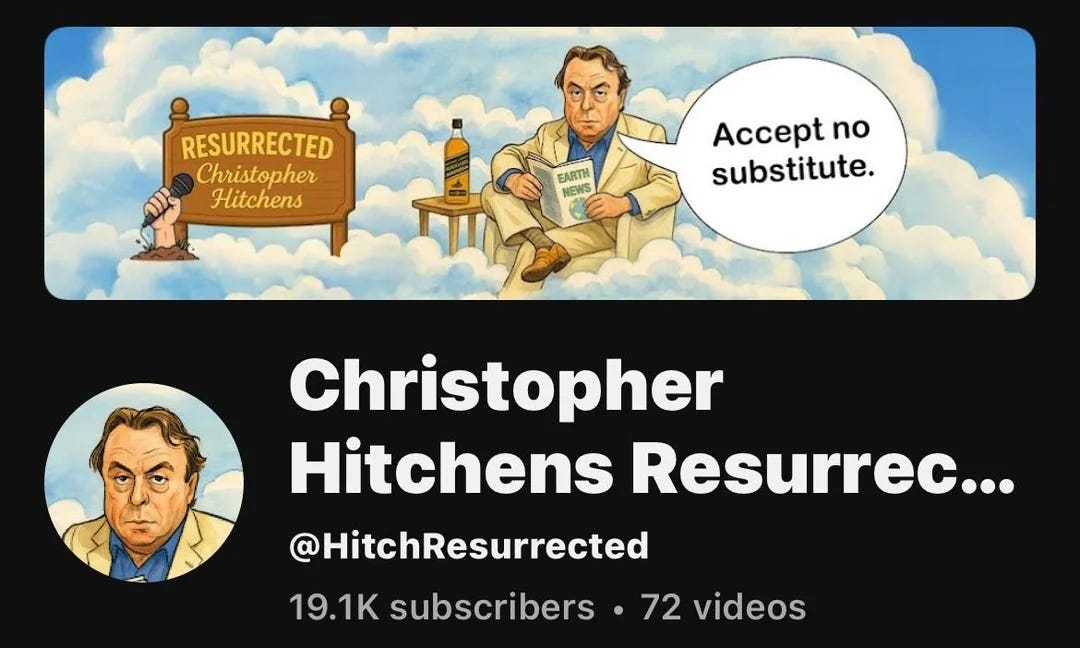
A YouTube channel called “Christopher Hitchens Resurrected“ produces AI-generated videos of him commenting on current events, his cadence and vocabulary reconstructed from everything he ever wrote and said. He skewers J.K. Rowling on trans rights, addresses various events in the Trump years, and essentially argues whatever the prompter requires. Despite its minute popularity, the act produces a Hitchens who would have been unrecognisable to his contemporaries, reducing his voice to a series of mausoleums and extended eulogies of a movement long dead.
New Atheism bet on reason to justify its positions on religion, foreign policy, and the meaning of life itself. Twenty years on, the culture wars they flamed have been replaced by others—each convinced it holds the truth, each powered by the swipe and scroll of X posts, YouTube videos, and TikTok shorts. Yet behind every culture war there are always horsemen, and behind the horsemen there are always people keeping the machine running with funding, network-building, and publishing deals.
Questions remain: Why had the Epstein network been so successful at capturing scientific publishing? How involved were they in the later development of New Atheism? What other internet-driven movements are not quite as ‘grassroots’ as one might expect? What are the long-term ramifications of New Atheism’s involvement with figures like Epstein on society’s perception of the epistemic authority of science? Who decides what reason is?
And what does this all mean for the future of culture and politics as the internet eats the world?
Author: Adam Taleem is an independent researcher and commentator writing on science, religion and philosophy.
Artist: All art has been hand-drawn for Kasurian by Ahmet Faruk Yilmaz. You can find him on Instagram and Twitter/X.
Socials: Follow Kasurian on Substack Notes, Instagram, and Twitter/X for the latest updates.