

The Liberal and Socialist Ummahs
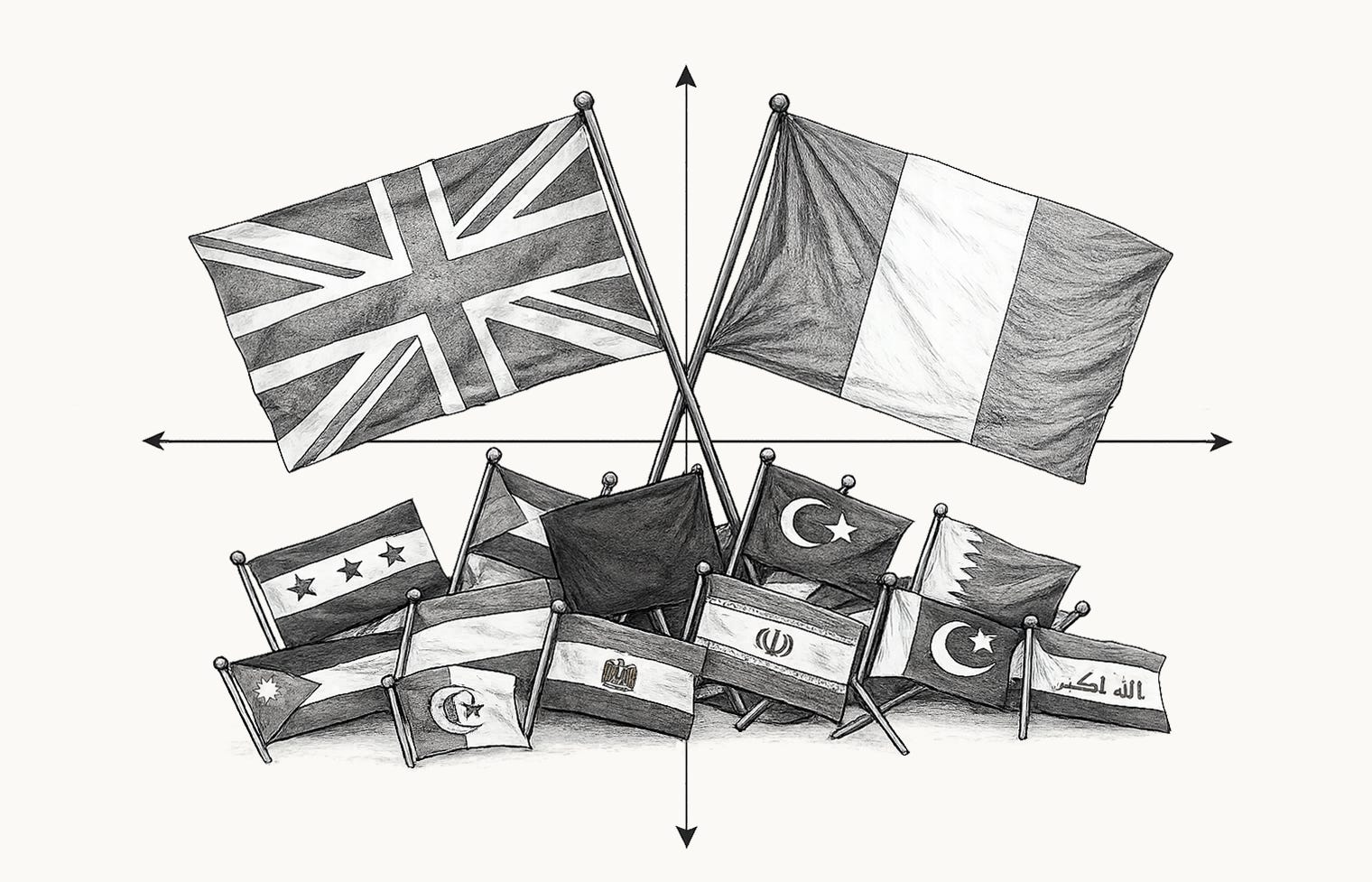
Manarism and Qutbism, the two competing wings of ‘Islamism’, are both descended from the liberal and socialist ‘ummahs’ of Europe.
Whether faith takes the form of an origin myth, a metaphysical system, a political ideology, or an ethical philosophy, it amounts to the same thing: a meaning that inspires collective action among otherwise unrelated individuals.
Secular politics, too, sits on deep theological beliefs about who humans are, how communities should cohere, and where history is moving. No matter how impious politicians can be, they operate within transnational faith communities that unify elites and guide the masses. Markets and armed forces can compel certain behaviours, but no society lives on exchange and coercion alone. Voluntary belonging, the kind that allows millions of strangers to identify as one people, requires something closer to faith.
While the concept of ummah is used almost exclusively within various ‘Islamic’ political and social causes, it has never been systematically applied to what the word more closely means, or, more controversially, to why that meaning is better represented by the European ‘big tent’ ideologies of liberalism and socialism than by the narrower ‘Islamic’ causes of the 20th and 21st centuries.
The Islamic idiom distinguishes two scales of such communities: a population that holds the same creed, and the civilisation that creed brings into being. The former is a millah, a spiritual formation in roughly the sense the secular world gives to ‘religion’: a set of beliefs and practices shared by a population. An ummah is something more, glimpsed through its related words umm (mother), amm (direction), and imam (leader). It is best understood as a community of universal faith that inspires a scholarly tradition, generates a historically conscious culture, and sustains many prosperous polities. Muslims constitute a millah, but they say ummah to name something that no longer exists, invoking it almost exclusively in lamentation of a lost, often romanticised heritage.
The two ummahs that actually organise modern life are not Islamic in origin. The first is the liberal ummah: the world order that grew out of the system of industrial capitalism that began to emerge in 18th-century England, with its parliaments, markets, newspapers, universities, and, later, its international bodies. Its faith is oriented to the private individual as the unconditional ground of public order, and is closely identified with professions such as the lawyer, the bureaucrat, the professor, and the journalist. Its mythology is the long ascent of liberty from absolute rule towards constitutionalism, and from clerical superstition towards enlightenment, revolving around terms such as reform, rule of law, civil society, and human rights.
The socialist ummah, on the other hand, emerged in the mid-19th century as liberalism’s most disciplined critic, and soon became its rival. Carried by labour organisers, party cadres, and the national-liberation movements of the colonised world, it placed the oppressed collective where liberalism had placed the private individual. Its priesthood was the party theorist and the revolutionary writer, and its promised salvation was a rupture for a new society. Through the late 19th and 20th centuries, the socialist ummah generated its own counterculture, built states, fought wars, lost some, won others, and at its mid-20th century peak commanded the loyalty of intellectuals across every continent.
Both ummahs drew from shared social histories. England gave modernity the initial concepts of property, parliament, commerce, and toleration. France gave it the republican ideals of citizenship, legal equality, and revolution as civic founding. Germany gave it philosophical depth and economic applications. Russia turned the French and German legacy into working revolutionary statecraft: forced modernisation, the solidarity of peoples, materialism as science, and anti-Western struggle on a global scale. Liberalism descended from the Anglo-French bourgeois class, and socialism mostly from the German and Russian revolutionary struggles. Most modern political thinking has happened between these two poles, with nationalists, fascists, and conservatives only trying to escape or synthesise them.
This is the background against which modern Muslims understood their world and built their madhabs. A madhab is a set of intellectual problems that earns durability by inspiring self-sustaining religious networks. It explains the problems, trains those who carry the explanation forward, and gives them a shared discourse within which to argue. While very few Muslims read Locke or Marx, the thought of such men belonged to the ruling political theologies of the age. Without its indigenous theory and methods, or usul, Islam drifts to whichever framework of power is in charge.
In the 20th century, two madhabs came to predominate: the Manarists and the Qutbists. Both claimed an ‘ummatic’ cause, yet were largely ensconced within the two greater ummahs of liberalism and socialism.
An Arab Ottoman Renaissance
In the mid-19th century, a wandering Muslim scholar named Jamal Al-Din Al-Afghani (1838–1897) experienced a familiar crisis of faith. Having spent his life moving among Calcutta, Bombay, Tehran, and Istanbul, he witnessed colonial rule at first hand and observed the limits of his (Muslim) ummah’s political organisation. After arriving in Cairo in 1871, the Persian-born exile held Arabic salons that attracted Egypt’s young minds. One question ran through all of the salons: Why are Muslims weak? Al-Afghani’s diagnosis lay in the structure of authority, and his cure was top-down: political reform, or revolution if necessary. As early as the 1870s, this was the first attempt at a Muslim theory of power in the industrial age.
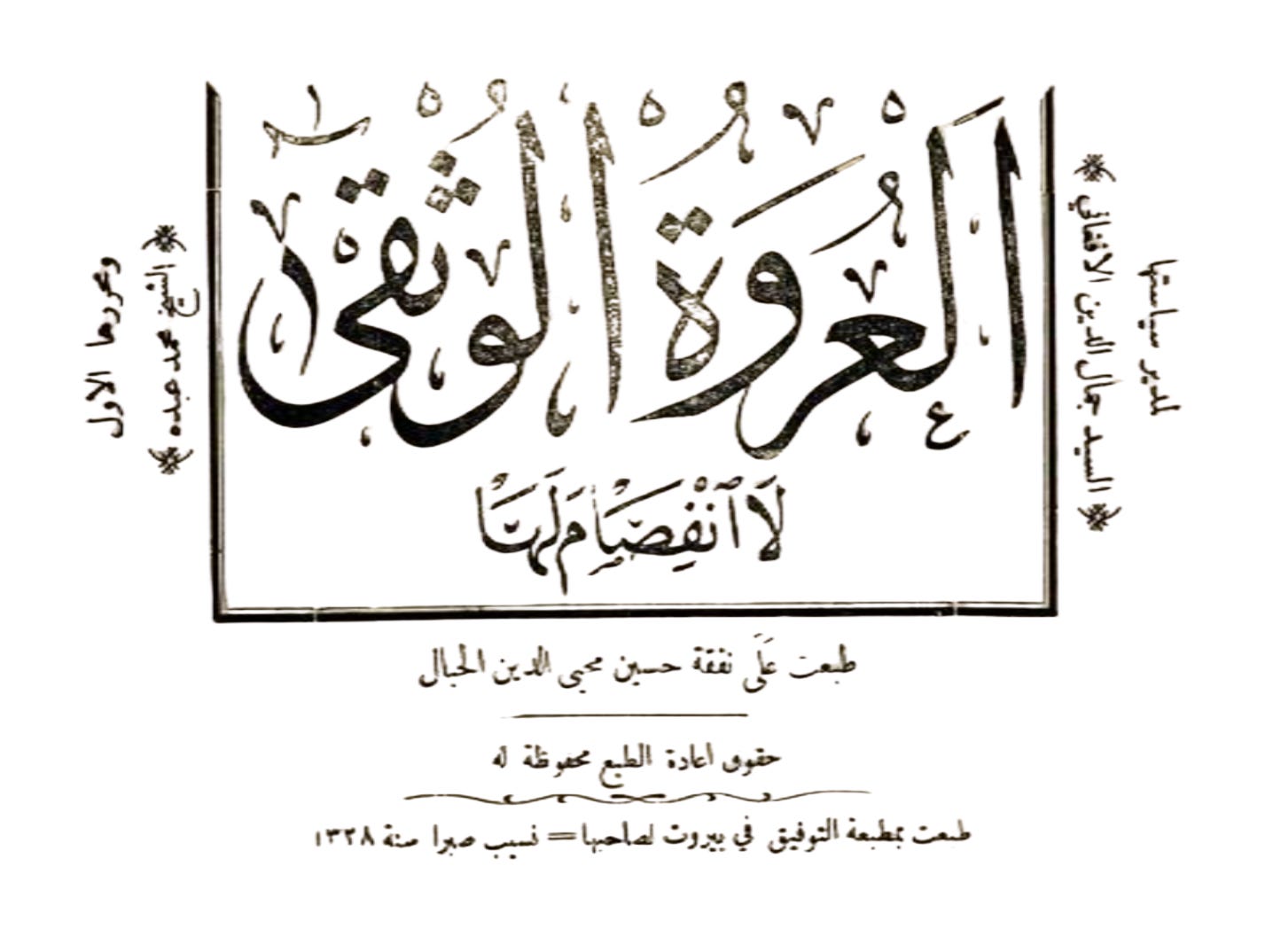
By 1879, suspicious Egyptian authorities arrested Al-Afghani and deported him to India. Three years later, British forces crushed the Urabi Revolt and arrested his student, Muhammad Abduh (1849–1905), an Al-Azhar scholar who had joined the uprising. The newly established colonial administration exiled Abduh to Beirut, which was then part of Ottoman Syria. From the Syrian coast, Abduh joined his teacher in Paris, where the two founded the short-lived journal Al-Urwa Al-Wuthqa, which called for pan-Islamic unity, resistance to foreign military occupation, and rational, forward-looking reinterpretation of Islamic principles.
After shifting to more moderate views, Abduh returned to Egypt in 1888 with the backing of British Consul-General Lord Cromer, who later supported his appointment as Grand Mufti in 1899. No longer a revolutionary, Abduh diagnosed the weakness of Muslim society as religious and intellectual decay: blind traditionalism, fatalism, and superstition. His cure was comprehensive educational reform: replacing rote learning with creative theological reasoning, and introducing modern empirical sciences alongside purified Islamic sciences. In 1897, Abduh was joined by his Syrian student Rashid Rida (1865–1935), who emigrated from Tripoli to Cairo to study with him. Thus, Al-Afghani, Abduh, and Rida would form the core intellectual spine of the first of the two madhabs that concern us, responding to and, in turn, being shaped by the increasingly dominant European ummahs.
The geopolitics were bleak. The flag of Saint George had flown over Delhi since 1858, and over Cairo since 1882. A marginal crusader kingdom, once driven into the sea by Ayyubid and Mamluk forces, now governed the heartlands of the Islamic world from a small island in the Atlantic. The Manarists reacted with curiosity rather than despair. Europe had achieved its dominance through the disciplined application of reason, science, and constitutional government, and Latin Christianity had reformed itself in the 16th century by stripping away medieval accretions and returning to scripture. Abduh’s line captured the Manarist adaptive vision: ‘I went to the West and saw Islam without Muslims, I returned to the East and saw Muslims without Islam.’
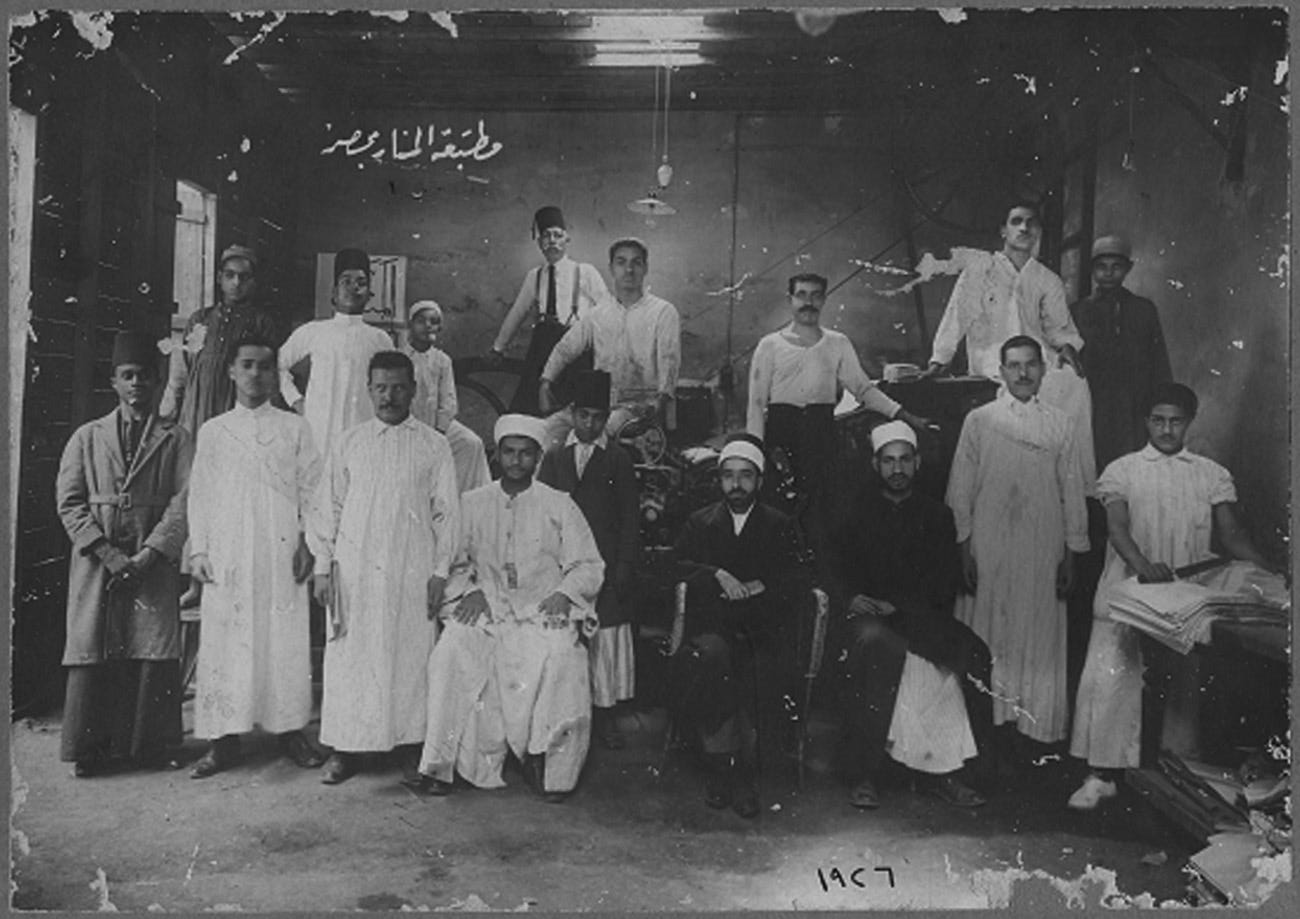
In 1889, Rida founded Al-Manar, a magazine dedicated to what later historians would call ‘reformed Salafism’: the purification of creed, the rationalisation of jurisprudence, and the cultivation of a literate and pious Muslim public. With a peak circulation of 2,000 to 3,000 copies, Al-Manar achieved immense global reach, functioning as an interactive network that published subscriber letters from Russia, India, Indonesia, Bosnia, and South Africa. New issues were routinely shared aloud in communal spaces such as mosques and coffeehouses, earning Rida a dedicated transnational following. The intellectual signature of the Manarist project was maqasid al-sharia, a theory about the objectives of Islamic jurisprudence. Rediscovering and republishing the work of the 14th-century Andalusian jurist Abu Ishaq Al-Shatibi, Abduh and Rida argued that the sharia is driven by purpose, not rigid rules, and that Islam’s entire legal tradition is designed to serve social welfare. This system is structured around a hierarchy of three protections: absolute necessities (daruriyyat), the core foundations of society, such as faith, life, and property; supplementary needs (hajiyyat), which remove undue hardship; and embellishments (tahsiniyyat), intended to improve quality of life. Medieval rulings could be revised if they no longer served these objectives, and modern institutions could be embraced if they served them better. This made room for railways, banks, elections, and women’s education.
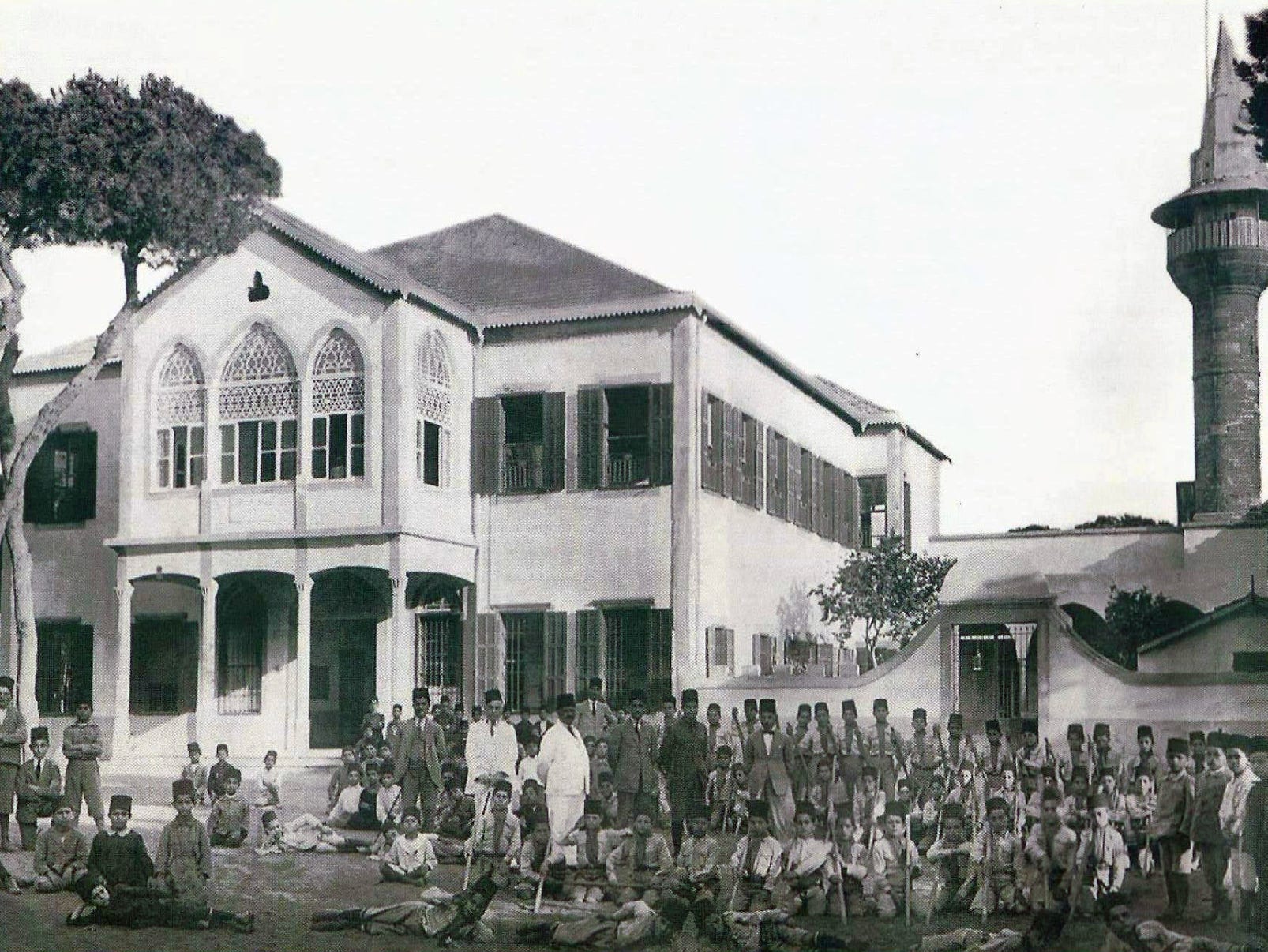
These ideas quickly found institutional expression in the booming port town of Beirut, where American Protestant missionaries established the Syrian Protestant College (later renamed the American University of Beirut) in 1866, and French Jesuits the Université Saint-Joseph in 1875. In 1878, the city’s Sunni notables founded the Maqasid Association, which ran modern schools, hospitals, and charities along maqasidi lines. Both the English and French academics and the Manarist founders shared an assumption: the future belonged to those who could combine modern science, technical education, and political competence with their inherited religious commitments. Out of this milieu emerged a Christian and Sunni political class that would govern Lebanon for three decades after its independence. They were, in retrospect, a Lebanese belle époque.
Muslim Modernity Under Attack
The Manarist madhab became characteristic of a particular social type in the Arab world: the teacher, the civil servant, the state mufti, and the reformist journalist. It was the political theology of the modernising Muslim city, from Beirut to Cairo, Hyderabad, and Tunis. It worked through scholarly learning and institution-building and treated state power with deference, considering Islam to be, in advance, compatible with whichever political authority would allow its institutional growth. Over the following decades, Manarist ideas would seep into a family of official Islamic establishments across the Muslim capitals, from Wahhabi quietism to Sufi traditionalism to more fringe branches like Quranism and Islamic progressivism. Across all these, Manarists were unified by a single ethos: reform under political strain, and the preservation of faith under cultural pressure.
Rida later served as president of the Syrian Congress in Damascus and helped draft the constitution of a proposed United States of Syria from 1919 to 1920: a federal, constitutional monarchy under King Faisal I. But the pressures that had set the Manarist project in motion broke the very world for which the project had been built. The assumption that modern education and reform would produce political sovereignty could not survive the fallout of the First World War, which created a new balance of power in the Middle East and the wider Arab and Muslim world. The Ottoman Empire was defeated, and Istanbul was occupied by Allied forces on 13 November 1918. On the morning of 24 July 1920, French forces crushed the Syrian-Arab dream of a post-Ottoman federal monarchy centred on Damascus. For Al-Manar‘s liberal-Islamic synthesis, that was a fatal blow. The networks of merchants and statesmen who were paragons of indigenous high culture were cut off. A disillusioned Rida abandoned his reconciliatory tone, placing his final hopes in the nascent Saudi state as the last unyielding bastion of Muslim power.
In the 1930s and 1940s, elite formation across the Muslim world underwent visible changes. The modern schools and lycées set up under European rule outpaced the reformed madrasas in producing the officers and administrators required by the new states. The triumphant liberal world order, as well as an emerging Soviet-led socialist rival, began to translate itself more rapidly into Arabic, each carrying a new political theology and, ultimately, an ummah. Positivism, secularism, progressivism, and other ideas descending from the two revolutionary traditions of Paris and Moscow overwhelmed Islam with the missionary energy of a young faith. Faced with colonial encroachment and military defeat, the children of the Manarist generation abandoned Islamic revival and let the Ottoman renaissance slip from memory. They took up a mixture of German nationalism and Russian communism: organic states, romantic history, anti-capitalism, vanguard parties, coercive modernisation, and solidarity of peoples against the West.
By the time Arab literacy had grown, Islamic ideas had stopped multiplying, and Manarism had lost its political cover. This Islamic offshoot of the liberal ummah never recovered the creative pulse of its pioneers, and it later dissolved into state-controlled clerical establishments. It survived in individual minds and souls, much like liberalism survived in goods and lifestyles, but both ceded the political arena to socialism and its own Islamic offshoot. The word muthaqqaf (cultured) became synonymous with Westernised, and ilm (science) bifurcated into strictly religious or strictly atheistic. The brightest Muslims studied secular law and secular history, while the less ambitious went to seminaries to become teachers or preachers. Manarists became quietists.
Religious elites were outcompeted at every level. The Western-trained intelligentsia organised better, wrote better, and imported the ethics and aesthetics the dominant socialist and liberal ummahs shared and patronised. Military officers did the rest. Revolutionary coups terminated civilian rule in Syria in 1949, in Egypt in 1952, and in Iraq in 1958, each offering the same package of anti-colonial rhetoric, political instability, and a security state that ruthlessly suppressed dissent. This led to the dismantling or hollowing-out of social and cultural institutions in favour of a single ruling ideology. Both the Manarist and adjacent liberal elites were accused of corruption, collusion with Western powers, and, most damning of all, responsibility for the loss of Palestine in 1948. Gradually, the 1950s notables gave way to the 1960s comrades.
The mid-century struggle for Syria in particular pitted a liberal, commerce-driven ummah against a socialist, class-conscious ummah. British-backed Iraqi and Jordanian monarchs pushed for a Hashemite-led Arab unity, while Egypt’s defiance of colonial powers inspired a dream of a larger Arab state extending into North Africa. Urban elites championed free trade and industrialisation, while peasant-rooted partisans demanded land reform and mass education. The tension between the slow, deliberative process of democratic reform and the radicalising effect of regional power dynamics tore apart the country’s political landscape. Even decades later, the Syrian intelligentsia was torn between supporting the 2011 revolution and preferring Assad’s dictatorship to an uprising backed by the Gulf monarchies and imperialism. Syria was caught between the Lebanese and the Palestinian conceptions of patriotism.
Separated from Syria and declared an independent republic in 1943, Lebanon held out longest. Its first prime minister, Riad Al-Sulh (1894–1951), was the architect of the National Pact, which embedded the East-West compromise in Lebanese public life. The Salam, Karami, and Al-Yafi families carried this political tradition forward across their premierships. With modern institutions distributed across confessional and commercial interests, Lebanon was less vulnerable to the kind of seizure of power that had brought socialist ideologues to power in the region. This kept the Manarist networks alive for a time, but the Palestinian refugee crisis soon strained this Arab hub of banking and publishing. The Cairo Agreement in November 1969 legitimised armed Palestinian action from Lebanese soil, introducing a mixed sovereignty that the country’s power-sharing formula could not contain. In April 1975, a civil war broke out involving socialist-led militias and Lebanese nationalist militias. The older Sunni tradition was broken, its space claimed now by pan-Arab nationalism and, a few decades later, religious fanaticism.
A Radical Divergence
Rida’s Saudi dream died shortly after his own death. After King Abdulaziz consolidated his rule in 1932, he incorporated Wahhabism into the state apparatus, keeping it firmly under royal control but showing no interest in exporting it as an ideology or pan-Arab project. The dynasty unified most of Arabia and settled into the role of a traditional monarchy within the British-led liberal ummah.
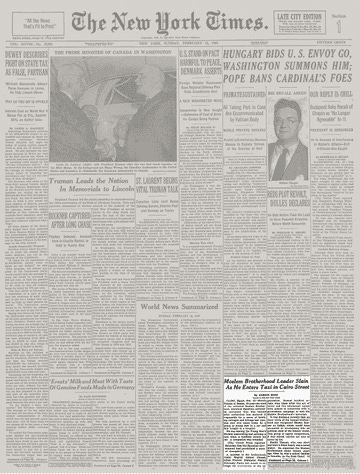
Between the abolition of the Ottoman Caliphate in 1924 and the loss of Palestine in 1948, an Egyptian Manarist built a new Islamic subculture that would later be the largest of modern times. Hassan Al-Banna (1906–1949) was a 21-year-old schoolteacher when, in March 1928, he gathered six workers from a British labour camp and founded the Muslim Brothers, the Al-Ikhwan Al-Muslimun. Al-Banna had concluded that his teachers’ vision had been inadequate for a collapsing world. What Islam needed was a mass movement with a disciplined organisation that could withstand political pressure and bring modernity into the lives of ordinary Muslims. He drew on the organisational repertoires operating around him: the cell discipline of communists, the secrecy and ritualism of the Freemasons, the youth wings of the fascists active north and south of the Mediterranean. When Al-Banna was assassinated on a Cairo street in February 1949, his Ikhwan movement claimed half a million members in Egypt alone, and many further branches across the region. They ran schools, hospitals, and even a paramilitary wing.
Comparable revivalist movements were emerging across the Muslim world, each indigenising anti-liberal organisational form and content. With the decline of the ancien régime, middle-class professionals born under colonial rule rushed to fill the cultural vacuum. In 1941, the Indian journalist Abu Al-Ala Maududi (1903–1979) articulated a theocratic-democratic vision for South Asian Muslims. In Jerusalem in 1953, the displaced Palestinian scholar Taqi Al-Din Al-Nabhani (1914–1977) founded Hizb Al-Tahrir, a party calling for a unified Islamic superstate governed by a Caliph. In the 1960s, future Iranian president Abolhasan Banisadr helped publish the Persian translation of Frantz Fanon’s The Wretched of the Earth, while the Sorbonne graduate Ali Shariati developed a liberation theology that blended Shia martyrdom with postcolonial critique. This intellectual brew would electrify hundreds of thousands of young Iranians who later overthrew the American-backed Shah in 1979.
The Ikhwan, meanwhile, lacked a distinct ideology. Marxism and Leninism were making inroads in Egypt, and secular nationalism was presenting itself as the language of history, liberation, and progress. Al-Banna’s writings were inspirational rather than tactical. Religious Muslims felt increasingly alienated in a world that was no longer theirs, and they needed their own vocabulary: something with literary force and worldly ambition. That vocabulary arrived through Sayyid Qutb (1906–1966), a literary critic and one of the sharpest Arabic stylists of his generation. On a study trip to the United States from 1948 to 1950, he felt disgusted with a society he described as materialistic, racist, sexually depraved, and spiritually empty. The education official, with little prior commitment to religion, returned home, joined the Ikhwan, and rose through their ranks. It was his prose, more than his religious knowledge, that gave the next Ikhwani generation its voice. The Ikhwan had backed Nasser’s republican coup but fell out with him when he moved to consolidate single-party rule and asked them to disband. Qutb was soon arrested in 1954, spending the next phase of his life in confinement, where he was tortured, watched fellow prisoners executed, and gave his doctrine its final form.
Qutbism was less a system of thought than a series of bursts of emotional energy. It produced no analysis of capitalism, empire, secularism, or the nation-state. It trained no intellectuals and bred no critics. What it offered was a charismatic vision and a victimhood narrative addressed to the educated classes of the postcolonial Muslim city, especially the rural migrants already uneasy about secular elites. Qutb’s central concept, jahiliyya, originally meant pre-Islamic tribalism, but he extended it to make it synonymous with both modernity and godlessness. History, he held, moved through rupture rather than reform. The world is divided into a corrupt majority and a conscious believing vanguard whose task is to bring about a new society. While this was the standard revolutionary frame of the 20th century, Qutb gave it an embellished Islamic clothing. Egypt was jahili, and rebellion was a religious duty. His work, Milestones, read like a call to arms. It was soon banned, and he was hanged on 29 August 1966.
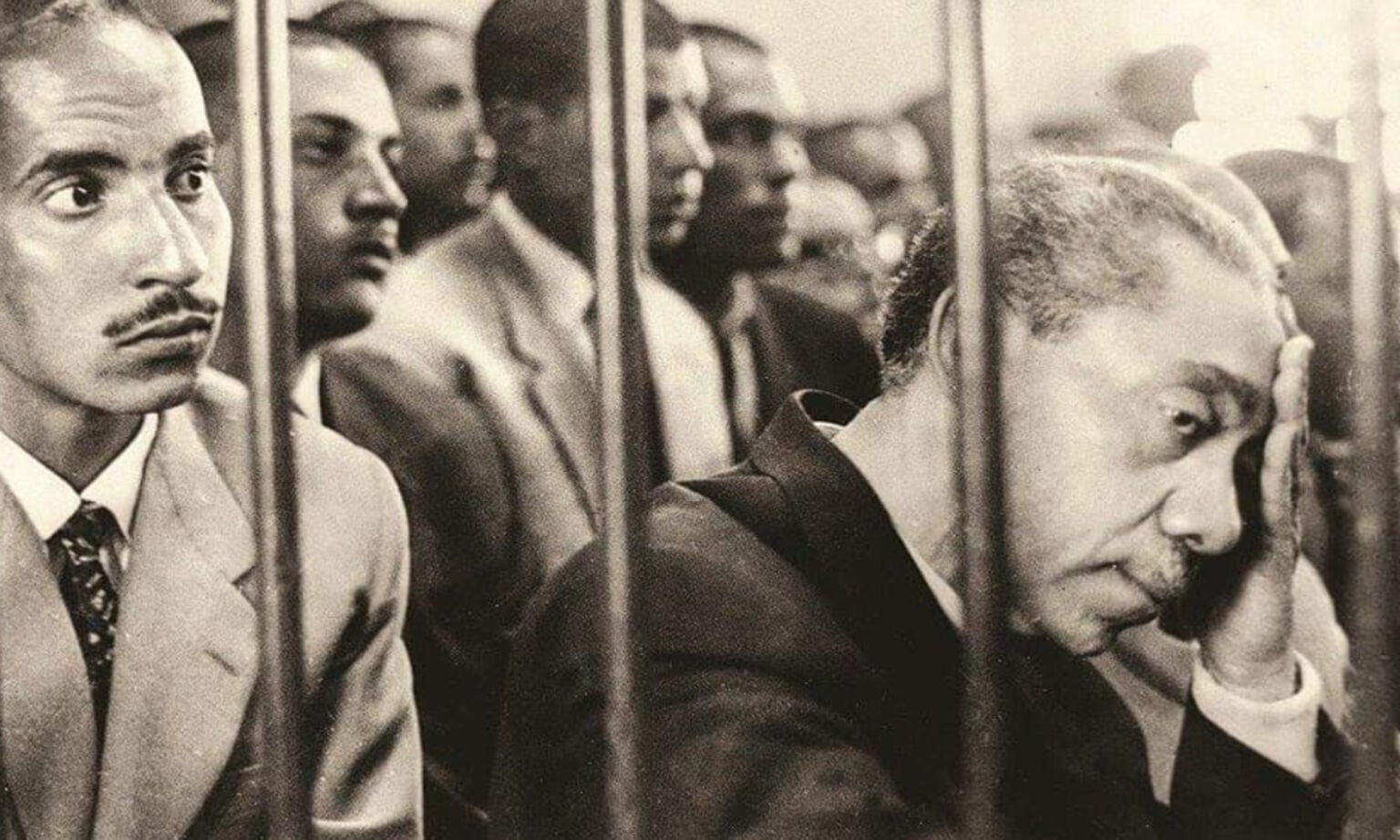
A year after Qutb’s death, the Arab armies suffered a swift and decisive defeat in the Six-Day War of June 1967, losing vast tracts of territory to Israel and displacing some 300,000 Palestinians. The catastrophe made Qutb’s martyrdom all the more symbolic, his diagnosis now vindicated by the defeat of the very regime that had killed him. While the Egyptian regime managed to contain Qutbists through both force and soft power, younger Ikhwani and Ikhwani-influenced Egyptians, particularly those fleeing the dictatorship to work in Gulf countries, adopted Qutbism and carried its revolutionary spirit forward. Many Islamist insurgencies against socialist regimes, from Afghanistan to Algeria, carried Qutb’s distinct declaration that these regimes and whoever supported them were godless and stood in the way of God.
Cultural Revivalism Without Culture
The crushing defeat of the Arab socialists in 1967 was part of a broader socialist failure. By the 1970s, the secular insurgent energy directed against the colonial West had begun to recede. Revolutionaries viewed global capitalism as a brittle, self-destructing system, but it proved far too resilient and adaptive. It absorbed labour demands, expanded mass consumerism, and weathered crises that radicals had predicted would be fatal. Meanwhile, the communist bloc collapsed under the weight of bureaucratic stagnation, failed guerrilla movements, and the human costs of famines, purges, deportations, and mass surveillance. The socialist ummah, which had positioned itself as the successor to the Western liberal order, dissolved under these accumulated moral and material defeats. In its wake, Qutbist Muslims inherited a displaced radicalism, as the insurgent willingness to die for a vision of total geopolitical rupture migrated into the Muslim underground.
In The Future Belongs to This Religion, Qutb presented Islam as a complete ideology capable of contesting modernity on its own ground; the Persian translator of that book was none other than the late Iranian Supreme Leader Ali Khamenei (1939–2026), who saw in the Qutbist drama a template for the politics he wanted in Tehran. In 1979, the first modern Muslim power to openly challenge both the Soviets and the Americans was born, pan-Islamic, anti-communist, and anti-Western at once. In the following decade, Arab and Afghan mujahideen, comprising exiled Ikhwani radicals alongside radicalised local tribesmen, fought the Soviets in Afghanistan and found in Qutb the justification for their war against a fallen global order.
Militant revivalism kept mutating. The Afghan war had turned Qutbism into a transnational fighting force; the American invasion of Iraq in 2003 handed it a cause, a battlefield, and a windfall of unemployed Sunni officers who brought professional military and intelligence skills to what had been an amateur insurgency. In zones of total state collapse, jihadism became a makeshift claimant to sovereignty, drawing unconsciously on the energy that had once produced the Third World peasant revolutions from Mexico to China while believing itself to be purely Islamic. The geopolitical function once performed by revolutionary socialism was now performed by Salafi-jihadism, giving Che Guevara an Islamic guise and defending Pol Pot-style atrocities with Hanbali textualism. Qutbism’s furthest mutation, the Islamic State of Iraq and Syria, was the most ambitious and most quickly discredited utopia of the era.
The socialist-led Arab states completed the turn in their own way. Having failed to develop their economies or indigenise a modern high culture, and having watched their ideals of unity and progress collapse, they compensated by building mosques, promoting state-sanctioned clerics, and accommodating populist conservatism to fend off dissent. The result was a cultural Qutbism: a thin, combative, superstitious religiosity obsessed with appearing Islamic while leaving every question about being, acting, and thinking unasked. The structures of power were not merely left untouched; they were the hidden directors. The pattern had its mirror in cultural socialism, where the liberal ummah absorbed its socialist rival as a lifestyle. Class struggle was dissolved into identity politics, and revolutionary zeal was domesticated into human-rights advocacy.
The wealthy Gulf became the cultural arbiter of this new world. Its rentier economy had long funded the missionary networks that fed cultural Qutbism, but its deeper export was a cultural liberalism that asked for nothing except luxury and integration into the global market. In pockets of secular intellectual life, especially in Tunisia, Egypt, and the Levant, this liberalism found a counterpart in a bigoted anti-Islamism that recast not only Islam but sometimes Arabness itself as a form of colonialism, reaching either for mythologised pagan identities or for wholesale globalisation. Two decades of post-2001 Islamophobia hardened the reflex and made Islamophilia, the parallel tradition with deep roots in East and West, look sterile.
From Multiple Blocs to One Civilisation
There is one ummah today: the liberal, Anglophone world order that grew out of industrial capitalism. Socialism itself could not make it to the 21st century. Everything since has operated within the liberal ummah, including Islamic movements like the Manarists and Qutbists.
The process of secularisation that came with the liberal and socialist ummahs did not take Islam away in the absolute, but rather imposed a hard limit to its scale. Muslims have been reduced from an ummah to a millah, from a civilisation able to address the whole world in a competent, authoritative language to a sect that broadcasts its politics as dreams.
The curtailment was hardcoded into the ‘purified’ national languages of the 20th-century Muslim world. Persians and Turks came to use millah for what Arabs call ummah, both of which mean a state-bound nation. Arabic even reaches for awkward expressions like the ummah-state, the ummah of citizens, or the Arab and Muslim ummah, leaving the original meaning visible enough to register as a wound. The socialists suffer the same condition, mourning their own lost ummah in roughly the same key. They invoke ‘the True Left’ or ‘the Global South’ mainly to mourn their missed utopias.
Every civilisation inhabits the world to inherit it, as classical Islam did in the 7th century. It survived as an ummah only because it brought its own elite culture, its own reading of history, and ultimately its own sovereign political theology. This is a shift modern Muslims across the political spectrum have failed to make, imagining Islam as an alternative bloc rather than a living force in a one-world reality. All flaws in worldviews, political methodologies, legal distinctions, and even social movements stem from the failure to recognise this most basic reality: that there is no alternative ideological existence. The fish do not know the water they swim in.
Author: Yaaser Al-Zaiat is a doctoral researcher at the School for Advanced Studies in the Social Sciences (EHESS) in Paris, where he studies conservatism in post-Ottoman Syria.
Artist: All art has been hand-drawn for Kasurian by Ahmet Faruk Yilmaz. You can find him on Instagram and Twitter/X.
Socials: Follow Kasurian on Substack Notes, Instagram, and Twitter/X for the latest updates.