

The Informal Economy is Pakistan’s Backstop
How Pakistan’s economy endures when its formal institutions fail.
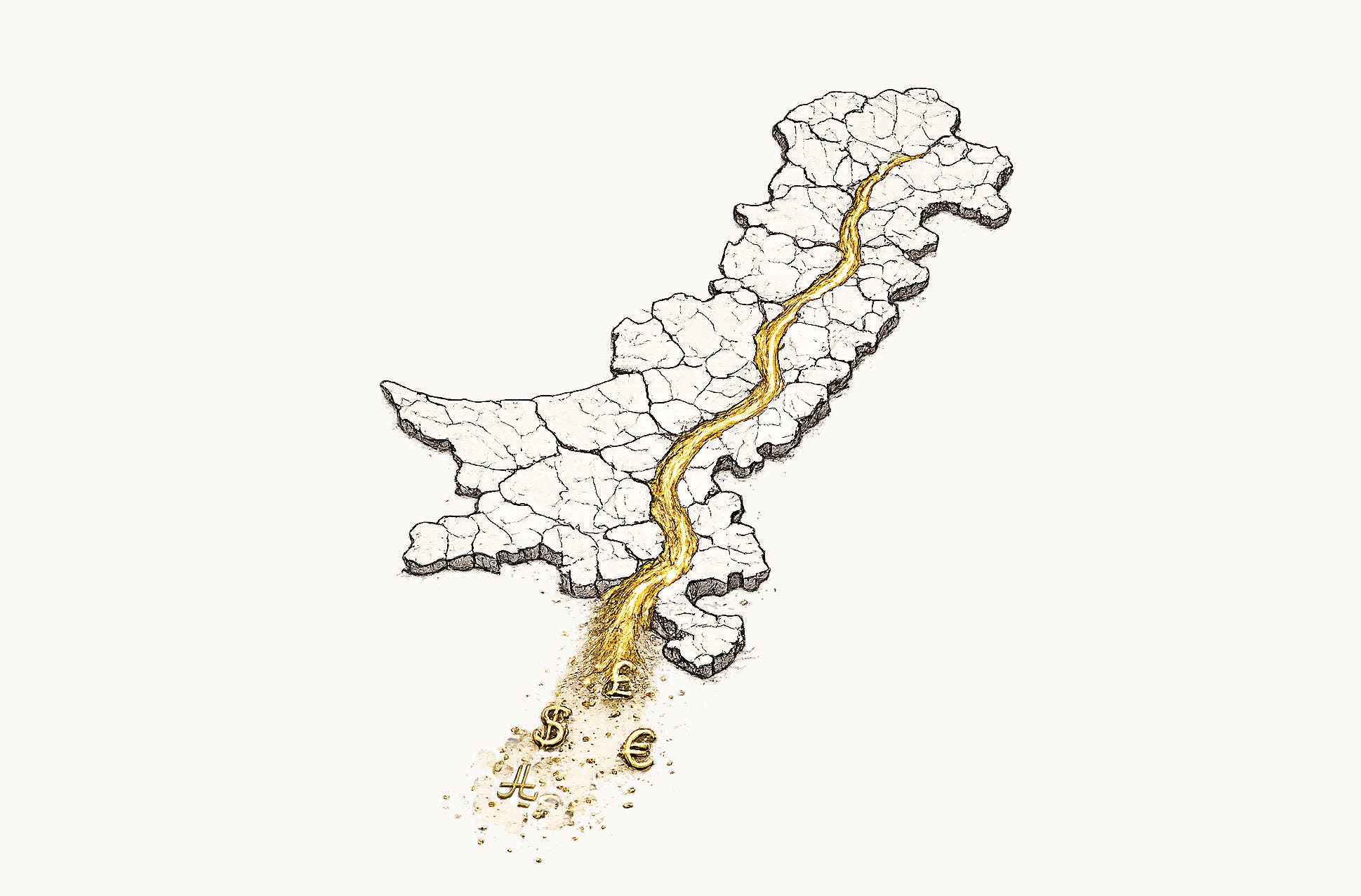
In June 2022, as Pakistan’s foreign exchange reserves fell toward levels that could barely cover a month of imports, the finance minister, Ishaq Darr, urged the nation to drink less tea. The government could no longer afford it.
For Pakistan, a country that drinks more tea per capita than almost anywhere on earth, that advice was not well received. One popular WhatsApp forward suggested Darr switch the government to tap water first. But the absurdity of the request was irrelevant compared to the absurdity of what Darr’s advice revealed: that a nuclear-armed state of 260 million people was publicly admitting it could not guarantee it could continue providing its population with its most basic daily ritual.
By December 2022, foreign exchange reserves—the stock of foreign currency the government holds to pay for imports and service its debts—had reached $6 billion, which meant there was barely enough to cover a few weeks of imports. From there, the situation worsened. The commercial banking system refused to open letters of credit, leaving containers stranded at Karachi’s Port Qasim and Keamari terminals. Fuel shipments halted, forcing factories in Faisalabad’s textile belt and Sialkot’s surgical instrument workshops to slow, then stop, for want of imports they could no longer finance. The official exchange rate, set by the central bank, had diverged so sharply from the street rate that currency traders in Karachi’s Bolton Market considered the gap itself to be a measure of institutional failure. At its widest, anyone using the formal banking system received roughly 10% less for their money than someone exchanging cash on the street, a tax on every transaction that touched the formal economy. In response, households hoarded whatever dollars they could find, and the elementary functions of economic life grew more expensive and less certain by the week.
Sri Lanka and Lebanon had already shown the brutality of what comes next in such a crisis. A collapsing currency leads to banks locking people out of their savings and, eventually, crowds in the streets. Ghana and Zambia reached the same endpoint through slightly different paths, but the structure was the same: a sovereign debt overwhelmed the state, the currency broke, and the formal economy quickly stopped functioning. By every macroeconomic measure, Pakistan was at least as fragile as Sri Lanka, Lebanon, Ghana or Zambia.
Yet when the Pakistani rupee depreciated from roughly 175 to the dollar in early 2022 to nearly 290 by the following January, Pakistan did not enter the self-reinforcing economic spiral that destroyed the Sri Lankan rupee or the Lebanese lira. Meanwhile, the political system, still paralysed by the fallout from Imran Khan’s ouster in April 2022 and the confrontation between his movement and the military-backed coalition that replaced him, failed to produce a coherent crisis response. The economy continued to function despite the damage.
The usual explanations as to why Pakistan did not collapse do not hold. State capacity? Pakistan has almost none. Control in Pakistan is split between civilian politicians and the military, neither of which is fully in command, resulting in a system where budgets lurch from one crisis to the next. Between 2018 and 2023, the country cycled through three prime ministers, two finance ministers per government on average, and four separate IMF programme negotiations—a discontinuity in governance that would have produced economic collapse in most states, yet Pakistan has somehow continued to survive.
What about institutional tenacity? Also doubtful. By 2023, interest payments alone consumed 60% of federal reserves, crowding out all discretionary spending and leaving the government with little capacity to do anything other than service its own debt. The State Bank of Pakistan technically had the usual central bank powers to manage inflation and steer interest rates, but the debt was so large that its basic function was reduced to ensuring the government could keep paying its bills. Banks directed over 70% of their lending toward the government; private-sector lending had fallen to roughly 14% of GDP, among the lowest ratios in Asia. The banks had essentially stopped being banks. Meanwhile, the tax-to-GDP ratio has hovered around 10% for two decades despite over two dozen IMF programmes since 1958, each of which has included tax reform as a core condition, yet none has actually implemented it. Economists call it fiscal dominance: a public debt so heavy that it effectively swallows every other function of economic governance. In country after country, it has ended the same way.
If survival is neither secured by the state nor guaranteed by its institutions, it must come from elsewhere. So where does it come from?
Pakistan’s Civilisational Economy
Pakistan does not operate as a single economy. Beneath the visible machinery of the modern state—the budget, the central bank, the commercial banks, the capital controls, and the recurring pilgrimages to the IMF—is a second system, older and more durable, organised around its peoples rather than its policies. It is also a system that economists have largely ignored, in part because it resists the quantification on which economic analysis depends.
This second economy is what we might call a civilisational economy: an informal ‘arrangement’ or system running on long-standing obligations and reputation rather than formal contracts, distributed across geographies in a way that allows it to operate independently of any single state. It is optimised for continuity amid extreme political uncertainty, with economic growth a mere afterthought, a secondary concern at best.
In The Bonds of Reputation, previously published on Kasurian, this mechanism is analysed at the level of trade governance between merchants and the privately ordered networks of diamantaires and Maghribi traders, whose reputational enforcement rivalled the bargaining power of nation-states.
Pakistan is perhaps the most enduring example of this mechanism applied at the macroeconomic level for an entire 21st-century nation of 260 million people.
The civilisational economy predates the formal economy, with trust cultivated within dense social networks and reputation carrying consequences that outlasted any court or sovereign state then in existence. Market exchange, therefore, assumed political instability to be the only perennial condition, and organised trade and relationships accordingly. One formal mechanism of this was the hawala system, which appears in Islamic legal texts as early as the 8th century and, by the 12th century, underpinned long-distance commerce from the Maghreb to the Malay Archipelago, allowing value and goods to move across vast distances. It did so, impressively, without ever physically transferring currency, while settling trade through brokers whose commercial survival depended on others’ reliability and honesty. Alongside hawala, trading families spread themselves deliberately across jurisdictions, distributing both family members and capital across borders so that inevitable disruption in one place would not bring down generational value in the rest.
When Pakistan came into existence in 1947, the governing institutions of this older order had already been dismantled. The Mughal revenue systems, the mercantile guilds of Lahore and Multan, and the many endowments that had financed public goods independently of the state intervening: all had been progressively eroded under British administration, which replaced decentralised, trust-based economic coordination with centralised extraction administered through the colonial bureaucracy. By the time Pakistan came into existence as a country, little remained to remember from pre-colonial times. The new country adopted the outward form of a modern nation-state with a budget, a central bank, and a comprehensive tax apparatus, but it lacked the institutional operations that such structures typically entail. Instead, it continued its pre-existing cultural patterns and instincts, never formally enshrined in state policies.
These patterns and instincts, now operating through modern labour migration, diaspora networks, and household-level obligations, held Pakistan together in 2022 when the ‘formal economy’ seized up. As banks froze and official channels collapsed, economic coordination migrated outside their formal institutions. and the civilisational economy absorbed the functions the state could no longer perform.
Importers began settling trade payments entirely outside the formal banking system, routing them instead through networks linking Pakistan to the Gulf, particularly Dubai and Riyadh. Rather than clearing payments through banks in the traditional way, brokers in these networks matched debts against each other so that one person’s obligation in Karachi cancelled out another’s in Dubai. For example, a Pakistani importer in Karachi owing $10,000 to a Dubai supplier would find his debt cancelled against a Pakistani trader in Dubai who owed the same amount to the importer in Karachi.
Pakistan’s connection with Dubai was especially critical. The UAE has long served as a clearinghouse for Pakistan’s parallel economy, where transactions are matched and settled outside any single country’s regulatory reach. Official bilateral trade reached $10.9 billion in the 2023-24 fiscal year. Pakistani traders in Dubai’s Deira district, many of them second- or third-generation merchants with family ties to Karachi and Lahore, operated as modern hawaladars, informal brokers who settle debts across borders through personal relationships and private bookkeeping rather than through any bank or even legal instrument. The formal banking system had been abandoned entirely. Households experienced the same bifurcation between formal and informal systems. Official remittance inflows through banking channels dropped roughly 20% year-on-year in late 2022 and early 2023.
The reason is straightforward. One need only ask why a worker in Jeddah would accept a lower rate from a bank when a hawala broker offered more rupees per dollar. In short, he would not. He would use whatever channel was best to keep his family in Faisalabad solvent. This is what led to billions of dollars moving from formal transfer services into hawala channels. The official data made it look like remittances were collapsing when they were actually just moving underground. The State Bank’s own data bears this out. Once the formal and street exchange rates had unified and the street premium collapsed in early 2023, official remittances surged again, confirming that the underlying flows had never actually declined, but had moved temporarily beyond the reach of formal measurement.
That is not to say that what occurred in 2022 was a recovery, per se. Ultimately, the currency stabilised only enough to avoid the self-reinforcing collapse that has destroyed many other monetary systems entirely. By the time Pakistan secured a $3 billion standby arrangement with the IMF in June 2023, the worst outcomes had simply been narrowly deferred, and nothing more.
The Roots of Pakistan’s Remittances
In 2023, Pakistan recorded roughly $26.5 billion in remittance flows—money sent home by the more than 9 million Pakistanis living abroad, mostly in Saudi Arabia, the UAE, the United Kingdom, and the United States—with actual remittances widely estimated to be significantly higher. This amounts to between 7 and 9% of GDP, making it one of the largest remittance economies in the world. Pakistan’s emigration numbers accelerated after the 1973 oil boom drew millions of workers to the Gulf, but the pattern itself is far older, a household strategy of dispersal now carried out through labour migration rather than trade.
Remittances in Pakistan behave differently from almost any other kind of money. Ordinarily, when an economy deteriorates, capital flees, foreign direct investment pulls back, sovereign lending dries up, and capital markets close. Remittances do the opposite. When inflation rises, or currency controls tighten, Pakistani households abroad send more money home, not less.
This counter-cyclical behaviour resists explanation by conventional economic market theory because it is driven by an obligation structure of family duty and communal responsibility. The macroeconomic effect is that household consumption continues when formal mechanisms of economic coordination fail, preventing the cascade from institutional paralysis to economic destruction and, eventually, social destruction.
The reason this works is that remittances enter the economy at the point where fiscal crises do the most damage and begin to cascade. A macroeconomic crisis is not the abstract outcome of a country being destroyed by GDP figures, but of the multiplication of household-by-household destruction. If a business cannot cover payroll, a family cannot make rent, or a shopkeeper cannot pay suppliers. Enough of these events happening at once produces the social pressure that puts crowds on the streets in Colombo while freezing Beirut’s banks. Remittances, however, interrupt that process entirely by keeping millions of households just solvent enough through the worst of the crisis. In this way, a son in Jeddah can send enough money to keep his father’s shop in Peshawar open, so that the shop’s suppliers can afford the rent. None of this activity at the household level appears in the macroeconomic data, of course, but it is ultimately reflected in fewer simultaneous defaults or fewer neighbourhoods that unravel at the same time.
Pakistan’s Informal Economy versus Argentina
Although this phenomenon is difficult to study in isolation, the contrast between Pakistan and Argentina makes it more concrete, especially since the two countries share more macroeconomic DNA than is commonly recognised. Much to the IMF’s anguish, both are serial defaulters with chronic fiscal deficits and recurring inflation. Similarly, both have currencies to which their populations have developed extensive workarounds because they are wholly distrusted. And both have spent decades cycling through stabilisation programmes that produce temporary relief followed by renewed crises. Argentina’s inflation exceeded 200% annually by late 2023, while Pakistan’s peaked near 38% in the same period. By any conventional metric, they should respond to economic crises in broadly similar ways.
Yet they do not. When Argentina’s formal economy fails, stress concentrates completely within the state and its formal institutions. In this way, it experiences a textbook crisis in which its currency collapses, the banking system freezes, and the full weight of the crisis falls on a population with little means of avoiding it. While Javier Milei’s election in November 2023, on a platform of radical dollarisation and central bank abolition, reflected many grievances, including cultural backlash, generational frustration, and the accumulated failures of Peronism, it was in part enabled by the absence of any buffer between institutional failure and the average household’s experience.
Argentina has informal workarounds, including the blue dollar market, off-book currency exchanges, and dollar savings kept outside the banking system. Yet it behaves nothing like Pakistan for two core reasons. First, because migration there has been episodic rather than structural. Second, because remittance inflows in Argentina have rarely exceeded $1.6 billion annually, which is well under 1% of its GDP. These two differences between the countries can be reduced to a single observation: an Argentine professional who moves to Madrid or Miami is making an individual decision about their own prospects, while a Pakistani worker who moves to Jeddah or Dubai is executing a household strategy in which their departure is the means by which the family manages existential risk across geographies and governments. The expectation that the Pakistani emigrant will remit is enforced by the same mechanisms of reputation and reciprocal duty that have overseen methods of trade and exchange for a millennium.
While both cultures have strong traditions of familial obligation, Pakistan’s obligation architecture was built by centuries of merchant diaspora networks, with trading families deliberately distributed across jurisdictions to manage risk and enforce remittances through reputational mechanisms that predate the state itself. There is no equivalent architecture in Argentina that connects households across borders; nor is there an alternative settlement infrastructure operating outside the banking system, just as there is no expectation embedded in social memory that those who leave will sustain those who remain.
Sacrificing Progress for Survival
Pakistan’s economic resilience is also an obstacle to progress. In a cruel irony, the very systems that prevent the country’s collapse may be the same systems that prevent it from evolving for the better.
Since its shocks are borne by those outside the state, so too are the political consequences that typically follow economic breakdowns. Often, reform occurs only when failure leaves no alternative; when the cost of inaction exceeds the cost of confronting entrenched interests so completely that even the beneficiaries of the existing arrangement cannot sustain it. South Korea’s chaebol reforms after the 1997 Asian financial crisis, as well as Indonesia’s decentralisation and banking restructuring after Suharto’s fall, both show that a systemic crisis, not decades of slow policy manoeuvres, motivated change. Pakistan’s civilisational economy blunts the fullest extent of a crisis, which is usually the catalyst for reform.
While nearly every crisis in Pakistan is bad enough to get attention from global media, the IMF, and its citizens, the informal layer absorbs just enough of the damage that no single issue ever becomes truly existential. Thus, households knowingly survive on remittances rather than demanding better public services, while trade continues through private settlements rather than forcing the government to reform the official channels. Foreign exchange circulates with limited friction outside banks, meaning nobody has to push banks to function properly for the economy to endure, even if only badly. Further, the elites who dominate the National Assembly have little reason to broaden the tax base when tens of billions in remittances they did nothing to earn are softening the consequences of their own narrow fiscal strategy. Meanwhile, the military keeps its grip on economic policy and its industrial conglomerates because the dysfunction its civilian fiscal decisions create never creates a reckoning between military and civilian power.
And so each crisis reinforces the conditions that produced it, allowing the system to remain in a stable equilibrium, in the sense that this exhausting cycle repeats. This stable equilibrium is not, of course, to be confused with a functional economy. Meaning, while the system delicately survives, it continues to deliver chronic unemployment, failing public services, and a tax base so narrow that the state cannot afford the population it governs.
Orthodox economics, shaped in an era of global expansion and market integration, struggles to sufficiently comprehend Pakistan’s endurance. Its frameworks measure states, comprising institutions and markets, with considerable sophistication, and yet these same academic journals have no vocabulary for familial obligation, long-standing reputation, or informal coordination as sources of macroeconomic stability. For this reason, Pakistan is consistently misdiagnosed in policymaking.
At the heart of the paradox, these same economists will claim, is that Pakistan’s continual economic rebounds are, in fact, little more than statistical noise; at other times, the country is mistaken for having institutional strength it does not possess, or it is simply reduced to a narrative of failed growth. These errors are not minor, as they shape policy with generational impact while simultaneously risking the erosion of informal buffers before formal institutions are even remotely capable of replacing them. In other words, the systems that policymakers and financial lenders seek to rationalise are often the very ones preventing the wider collapse that would make rationalisation impossible.
It is assumed that growth and stability are expressions of the same underlying condition, and that a system that does not grow is failing. Pakistan proposes an entirely different orientation to this theory. Its civilisational economy is optimised for continuity under repeated threats of collapse, not for growth. It prefers redundancy and contingency over the type of efficiency that only functions when the future can be taken for granted. As the institutional strength of the late 20th century is hollowed out, and as markets thin and finance becomes politicised with the rules-based order fraying, the distinction between redundancy and efficiency becomes urgent.
The question that should occupy the minds of macroeconomists today is that of Pakistan’s very condition: which systems endure when conditions deteriorate, and what does endurance cost the societies that depend on it?
Author: Sinéad O’Sullivan is a systems economist with an interest in institutions and their cultures, formerly at Harvard Business School and MIT Sloan School of Management.
Artist: All art has been hand-drawn for Kasurian by Ahmet Faruk Yilmaz. You can find him on Instagram and Twitter/X.
Socials: Follow Kasurian on Substack Notes, Instagram, and Twitter/X for the latest updates.