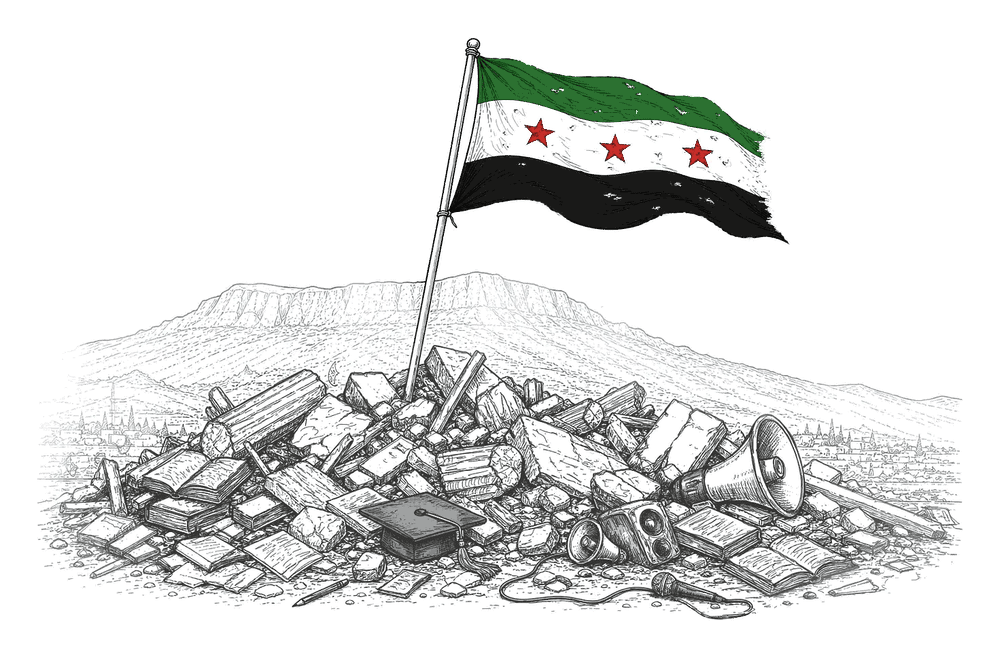
There is a figure that haunts the academic halls dedicated to the study of the Middle East and the Muslim world. This figure—the Sacrificialist—is the dominant voice in a field that was once animated by the ambition to understand civilisations in motion but has since contracted into something closer to a liturgy of defeat. The Sacrificialist is not a person, but a posture within the broader currents of the Arab, and sometimes Muslim left. It is a moral economy consisting of academics, activists, and citizens alike, one where losing is seen as the truest form of winning, and where the willingness to demand “sacrifice”, however material or symbolic, is the primary measure of seriousness and belonging. They are trained in critique and fluent in the vocabulary of loss, cite Edward Said as though reciting scripture, invoke Michel Foucault as one might an incantation, and produce work that, for all its sophistication, rarely outlives the journals in which it appears.
The Sacrificialist’s habitat is the contemporary academy, but their condition transcends its halls. Abdurrahman Taha, the Moroccan philosopher, draws a distinction between qawl, the mastery of articulation and speech, and ʿamal, the ethical deed that transforms the self and bears responsibility for its consequences in the world. In a moral order in which qawl displaces and suppresses ʿamal, it is technique that governs knowledge and reduces the world to what can be measured and proceduralised, while the formation of the moral subject through action is relegated to an ever-shrinking private interior, if it survives at all. The highest achievement is mastery of critique itself, severed from the burden of ethical action: the performance of having named the violence, again and again, until the naming becomes indistinguishable from belonging. But this moral order, as Wael Hallaq argues, does not merely produce speech in place of action. It acts relentlessly, driven by the imperative to do whatever can be done, and retroactively cloaks that action in the language of legitimacy. Speech is not an alternative to the exercise of power; it is its laundering mechanism. Hallaq calls this discursive moralism: a world in which moral language functions not to cultivate virtue but to sanitise violence. Critique, in this account, cloaks what he identifies as a faux-transcendence, in which abstractions like ‘justice’ or ‘anti-imperialism’ divide the world into the righteous and the damned while keeping the speaker's ego safely innocent.
The politics of our time claims to operate on pragmatic and material terrain—and yet political life remains saturated with moral intensity. The need for an ultimate reference point of accountability did not vanish with the departure of the divine but was instead reassigned to the political realm. Politics today is secularised theology, promising progress or justice as absolutes, but without any higher ethical constraint capable of checking the ego’s appetite for its own innocence—the impulse to declare ourselves righteous. This is the atmosphere in which the Sacrificialist thrives, because the Sacrificialist’s entire vocation depends on the availability of a moral register that can certify righteousness without requiring transformation.
The post-Saidian academic order is one of the most refined products of the Sacrificialist’s condition. Said’s Orientalism was, and in certain contexts remains, a sharp tool for exposing how Empire distorted and subordinated the histories of those it colonised, revealing the mechanics of knowledge as domination. One could use it to cut through, then pivot towards articulating alternative ways of knowing, organising, and living, drawn from intellectual and ethical inheritances that the colonial gaze had obscured. But over time, Said’s tool calcified into orthodoxy. Said himself did not demand this (though the argumentative circularity of the original text made the calcification structurally possible), but it was the academic order that inherited him which discovered that critique, endlessly sustained and never resolved into construction, was a comfortable dwelling. This academic order required no departure from discourse and asked nothing of its practitioners beyond the correct alignment: leftist, Marxist, decolonial, and above all, safely critical. Citing the right people became a mode of affiliation, the reflexive disclaimer a credential, not a genuine reckoning with the ground one speaks from. The post-Saidian order became a ritual of admission into a moral consensus that had already decided its conclusions before the inquiry began.
The Post-Saidian Order
If this orthodoxy had remained confined to the academy’s seminar rooms and conference panels, its consequences would be academic in the most diminishing sense of the word. But it did not, and here the Sacrificialist encounters a paradox. The same scholars who endlessly perform their own marginality—we are only academics, no one reads us, our work cannot reach beyond the seminar room—have produced a moral vocabulary that has escaped the university more thoroughly than almost any intellectual movement in living memory. Structuralism never managed it. Even neoliberal economics, which reshaped the world more thoroughly than any academic project of the 20th century, escaped the university primarily through policy corridors and institutional capture rather than through cultural osmosis. The Sacrificialist’s idiom, the post-Saidian order, did something rarer. It seeped into the groundwater of public discourse, surfacing in vertical video and social media threads, in the moral grammar of protest movements, and even the intuitions of educated publics who have never read a page of Said yet think in categories his work made available.
What the post-Saidian order accomplished is, by any measure, remarkable. This achievement, however, is also what renders the orthodoxy genuinely dangerous, because once an idea becomes common sense, once it stops feeling like an argument and starts to feel more like reality, it becomes nearly impossible to challenge. An argument can be tested, a theory can be falsified, but an intuition simply feels true, and the post-Saidian moral vocabulary now operates at the level of intuition.
The moral language of anti-colonial critique, a language meant to expose how power works and to inform how one acts in the world, has detached itself from ethical action and now functions as a sorting mechanism, dividing the world into the righteous and the implicated, the aligned and the suspect. What was once a scalpel for dissecting the relationship between knowledge and power has become an atmosphere in which certain positions are simply felt to be correct, and others felt to be compromised, without the intervening discipline of argument.
The consequences go beyond the academy. Once critique without political imagination escapes the academy and becomes the common sense of movements and publics, it reshapes the horizon of the possible. Justice, in this framework, means a complete restoration that history almost never delivers. Justice, then, begins to function less as a practical demand and more as a permanent warrant for prolonged war, siege, and resistance that cost lives, since the struggle cannot cease until an impossible justice has been achieved. The dynamic feeds itself. The Sacrificialist creates or refines the vocabulary, the receptive public amplifies it, and the vocabulary hardens against revision. The loop creates a critique divorced from any viable political imagination, and it does not merely fail to end suffering but, under certain conditions, sanctifies suffering as the only proof of moral seriousness, and the demand to resist, and keep resisting, becomes a form of coercion, an authoritarianism that denies those it claims to champion the right not to die.
This denial has material consequences, with a name, a geography, and a death toll.
How the Academic Left Failed Syria
Syria was one of the few moments in the modern Levant where action, messy and fragile as it was, successfully broke free from the gravitational pull of endless critique. The revolution that began in 2011 unsettled the entire architecture of the post-Saidian moral order, not because it was pure but precisely because it was not, and because it refused to wait for purity before acting. Revolutionaries from diverse walks of life, urban and rural, secular and devout, educated and unlettered, pursued liberation on terms that did not submit to the binaries through which the academic left had learned to process struggle. There was no clean colonial antagonist, no singular axis of domination that could be mapped onto the coloniser-and-colonised template the orthodoxy required to render a conflict legible. The violence was internal, multidirectional, and often enacted by actors who occupied several positions simultaneously: victim and perpetrator, resistant and authoritarian, anti-Western and Russian-armed. The left, both Arab and Western, looked at this and largely turned away.
The turning away was a structural consequence of the very framework through which Sacrificialist solidarity had been trained to operate. Post-Saidian thought, for all its suspicion of empire, inherited the gravitational pull toward power that it claimed to diagnose, only with the poles inverted. In rejecting the West as the locus of domination, much of the decolonial left re-centred virtue in what it designated the anti-imperialist camp, namely Iran and Russia, whose own imperial histories and present ambitions were quietly reclassified as defensive postures against Western aggression.
“Anti-imperialism” became the most persuasive sacrament of this secularised political theology. Within this structure, Iran and Russia ceased to function as mere geopolitical actors and began operating as surrogate transcendences. Their opposition to the West granted them a moral immunity that no evidence can revoke. Even today, violence committed under their shadow is not defended so much as reclassified: tragic but necessary, regrettable but “contextualised,” unfortunate but (and this is the decisive word) aligned. Assad’s regime could therefore be folded into an “axis of resistance” not because its conduct was defensible by any standard the left claimed to uphold, but because alignment, a position held up only by the feedback loop of critical speech, had become the ethical measure. Once positioned against the correct enemy, power no longer needed to answer to an external moral limit. It answered only to itself.
For years, the Assad regime’s violence against Syrians, and the industrial-scale detention and torture documented by defectors and survivors alike, was met in many leftist and decolonial spaces with hesitation, silence, or outright denial. But what is more revealing than the denials, some of which can be attributed to ignorance or cowardice, is how the same logic persists even now, even among those who have always opposed Assad, whenever Syria re-enters public discourse. The post-Saidian intuition resurfaces as a reflex. Syria acquires moral weight through proximity to a sanctioned struggle. “Intersectionality,” insofar as it intersects with Palestine, becomes the mechanism through which some violence is seen, while Syrian suffering, absent that intersection, remains in the shadow.
The case of Yarmouk best exposes this dynamic. A district in south Damascus that had grown from a Palestinian refugee camp, Yarmouk was besieged, starved, and ultimately destroyed by the Assad regime and its allied militias from Lebanon, Iraq, and Iran. Today, within the post-Saidian discourse, Yarmouk is undeniable evidence of Assad’s betrayal of Palestine, as though the destruction of a Palestinian camp is the threshold at which Assad’s violence finally became fully legible. Assad committed violence against Palestinians, and therefore, his violence can now be admitted into the register. The implication, rarely stated but repeatedly enacted, is that Syrian suffering on its own, the hundreds of thousands of dead who were not Palestinian, who lived in Homs and Aleppo and Daraa and the suburbs of Damascus, required translation into a recognised symbolic vocabulary before it could be seen. The Palestinians of Yarmouk supplied that translation, becoming a cleansing register for the post-Saidian order’s attempt to absolve itself. The Sacrificialist needs this register because, without it, the binaries dissolve, leaving the terrifying prospect of judging each situation on its own terms and acting without prior assurance that one’s position has been certified as righteous.
Palestine offered the ideal conditions to wrest Syria into legibility: settler-occupied, with a clear geography of domination, and a moral clarity that made solidarity both intellectually legible and, more importantly, safe for the post-Saidian order. Syria offered none of that comfort. Its people were fragmented, its frontlines impossible to narrate in a single direction, its actors compromised in ways that demanded distinguishing between resistance and tyranny inside an ostensibly anti-Western bloc. In short, the orthodoxy could not take up Syria without dismantling itself.
Syria exposed something deeper than a failure of solidarity. Much of the Arab and Western left cannot imagine sovereignty outside the imperial frame. They refused the American umbrella only to accept Russian and Iranian cover, trading one master narrative for another. What followed was a politics of sacrificial alignment, where positions turned less on the texture of a given struggle than on who armed whom and who fought the designated enemy.
Instead, the revolution, whatever its failures (and they were many), was populated and made by people who acted without metaphysical cover or assurance that history would vindicate them. Nor did they wait for the correct sponsor to authorise their struggle. And for precisely this reason, the constituencies that have made solidarity their vocation abandoned Syria.
Sovereignty Does Not Wait for Permission
Today’s political culture insists that ethical clarity must precede action, that justice must be perfectly legible before it can be pursued, and that one must know in advance which side of history one is on before stepping into it. This is the Sacrificialist’s deepest assumption, and it is wrong, because it reverses the actual sequence of moral life. The ethical deed is the means by which the self is formed, tested, and brought into relationship with a moral order that exceeds it. Divine will, in this account, is not something that intervenes from above to settle our dilemmas in advance. It is enacted through human will and the willingness to choose amid radical imperfection. There is no exemption from mess. There is no metaphysical clearance granted before the fact. To act ethically is not to escape uncertainty but to enter it deliberately, carrying the full weight of the knowledge that one may be wrong.
What the post-Saidian order has trained those inside and outside the academy to do instead is to delay action indefinitely until suffering can be translated into a recognised moral register, so that the struggle can be declared righteous by the correct authorities, thereby securing alignment. The order routes one struggle through another, outsourcing judgment to empires, movements, or symbols that promise moral safety, and calls this solidarity. This is actually self-preservation masquerading as justice.
The first step toward sovereignty, and this word is used deliberately, because what is at stake is not merely an intellectual posture but the capacity of peoples to govern their own fate, is acting without subordinating one struggle to another, or waiting for the framework to guarantee one’s innocence, or outsourcing moral judgment to the geopolitical patron, the academic consensus, or the social media chorus that will confirm you have chosen correctly. The Sacrificialist is not allergic to injustice but to the possibility that acting in the world will compromise the carefully maintained purity of a position that was never tested against anything more demanding than a conference paper. They are invested in appearing moral far more than in acting with morality, because action requires choosing, prioritising, excluding, and risking failure in public, and failure in public cannot be absorbed by the citational apparatus that has sustained them thus far.
Syria, whether the Sacrificialist accepts it or not, exposed this with a brutality that no amount of retroactive reframing can soften. The revolution was not pure, and no honest account of it can pretend otherwise, but it was populated by people who acted without permission. They did not wait for Sacrificialist intellectuals to settle on the correct narrative, or to endorse them as the right kind of resistance, or for the solidarity movement to add them to the list of causes already deemed worthy of attention. They acted, under unbearable conditions, knowing they might fail, knowing history might not vindicate them, knowing that no framework would assure their innocence in advance. Some built, and others governed, however imperfectly and briefly. Many more died. And in their refusal to subordinate their own agency to the moral economy of others, they enacted something that the entire apparatus of post-Saidian critique, for all its sophistication, has proven incapable of producing: a politics that accepts the risk of being wrong in order to pursue the possibility of being free.
A politics that only “resists” is not politics. It is mere posturing that waits for history to move and for death to sanctify its stance. And justice is not an abstraction; people build it, govern it, restrain it, and repair it. It is the work we undertake, knowing we may fail. In the end, it is often the act undertaken without certainty that manifests the divine will and moves history forward.
Words: Sarah Al-Saeid is a researcher and humanitarian practitioner working on Syria and the wider region.